

Short answer: Lock the scope before the first enquiry, because occupancy type and attachment method decide the engineering before anything gets priced. Get five specification figures in writing to make quotations comparable. Treat compliance documentation as a deliverable with a named testing body and a report reference. Run the container arithmetic before comparing unit prices. Lock colour and profile if the order is phased. And order one sample before ordering forty.

Buying one pergola and buying forty are different exercises. A single unit is a product decision. A hotel terrace, a restaurant group rollout or a distributor’s opening order is a supply decision, and most of what goes wrong sits outside the specification sheet: batch consistency, container arithmetic, documentation for the plan check, and what happens when unit nineteen arrives with a bent blade.
This is a guide to the questions worth asking before a purchase order, written for project buyers and for distributors placing their first container.
Lock the Scope Before the First Enquiry
Suppliers cannot price or engineer without site specifics, and back-and-forth on basics costs weeks of a build programme.
What to gather first
Total covered area or module count. Site exposure, which for structural purposes means coastal, high altitude or a known wind corridor. Occupancy type, since a restaurant terrace, a pool deck and a retail courtyard sit differently under code. And whether the structure is freestanding or building-attached, which changes the engineering scope entirely.
Occupancy also decides which risk category applies under the IBC, and that shifts both the structural requirement and the documentation threshold before anything is quoted.
System type changes the supply problem
Open-frame, solid or polycarbonate roof, and motorised louvered systems each carry different implications. Motorised units add three items to the spec: electrical coordination, drive specification, control integration. The wider comparison sits in pergola roof types compared. Suppliers strong in one type are frequently weak in another, so knowing which system the project needs before the first call filters the list on its own.
Decide What Kind of Buyer You Are
The two roles want different things from the same supplier, and confusing them wastes time on both sides.
Project buyer
One site, one delivery window, a fixed number of units, and a completion date other trades depend on. Priorities run to lead time reliability, documentation for the permit, plus a single point of contact when something needs resolving mid-programme.
Distributor or main contractor
Repeat volume, stock held between orders, and a margin that has to survive freight. Priorities: container density. Consistency between batches placed months apart. Spare parts availability. And whether the supplier will sell to your competitor down the road.
Where they overlap
Both need the same three things confirmed in writing before an order. What the structure is rated for. What arrives in the crates. What happens when something is wrong.
The third gets skipped most often, and it is the one that matters at three in the afternoon on a Friday when a crane is booked.
| Stage | Project buyer | Distributor or contractor |
|---|---|---|
| Before quotation | Site constraints and permit position | Target price point and stock plan |
| Comparing suppliers | The five specification figures | The five figures plus container density |
| Documentation | Test data for the plan check | Certification set for downstream customers |
| Sample | Confirms finish and assembly time | Confirms saleability and install labour |
| Order | One delivery to a fixed date | Repeat volume with batch consistency |
| After delivery | Handover pack for the operator | Spare parts and warranty administration |
Specification Before Price
Quotations only become comparable once the same figures appear on both.
The five numbers
Post section and blade section in millimetres. Coating thickness in microns with the pretreatment beneath it. Rotation range as a number. Drive rating with its ingress class. And any wind or snow figure quoted against the module size it was tested at.
What a US commercial spec adds
On projects going through American plan check, the specification carries further line items that a residential quotation never mentions.
Design wind pressure referenced to ASCE 7-16. Snow load in pounds per square foot alongside the metric figure. Live load. Maximum allowable clear span for the stated load case. And a deflection criterion, where L/180 is the common commercial benchmark.
Coating gets its own threshold. AAMA 2604 is the specification most commercial projects call for on powder coat, and a supplier who cannot reference a coating standard in their product data is not working at that level.
| Line item | What to state | Why it gets asked for |
|---|---|---|
| Design wind pressure | Referenced to ASCE 7-16 | Governing structural case in most US jurisdictions |
| Snow load | psf alongside the metric figure | Local design values are set in imperial |
| Live load | Stated separately from snow | Reviewed independently |
| Maximum clear span | At the specified load case | Determines module count and post layout |
| Deflection criterion | L/180 is the common commercial benchmark | Decides whether a span passes |
| Coating standard | AAMA 2604 is the usual commercial call | Screens residential-grade finishes |
| System weight | Per module, in writing | Foundation and footing calculation |
| Drive rating | Voltage, force, duty cycle, IP class | Electrical permit and long-term service |
Weight, span and module size
Structural designers need system weight for foundation and footing calculations, and they need it in writing. On an elevated deck or a rooftop terrace it stops being a detail and becomes the governing input. Ask for maximum clear span at the specified load case, maximum blade length, and weight per module.
A quotation missing wall thickness and coating thickness is not comparable to one that states them, and the gap between two suppliers writing the same product description is routinely a factor of two on both. What the mechanism involves covers why each figure matters.
Why coating gets thinned first
It is invisible on delivery and decisive several winters later. Nobody inspects microns at goods-in, which is exactly why it is the first thing cut when a supplier is asked to hit a number.
For a worked example of what that line should read like on a quotation: the alux steel range is specified as chemical passivation, then a zinc-aluminium-magnesium base, then roughly 80 microns of powder, with 168 hours of salt spray and 100 hours of UV behind the figure. Three entries, not one.

Sections vary by series
alux steel systems use a 100 by 100 mm post carrying a 123 by 19.8 mm blade on the ST-100-A or a 150 by 34 mm blade on the ST-100-B-KD. The aluminium AL-120-A-KD pairs a 120 by 120 mm post with a 158.8 by 34.7 mm blade in 6063-T5, its blades turning through 0 to 180 degrees. Material selection between the two ranges is covered in steel versus aluminum.
Permits, Codes and Documentation
This is where project orders separate from consumer ones.
Which permits to expect
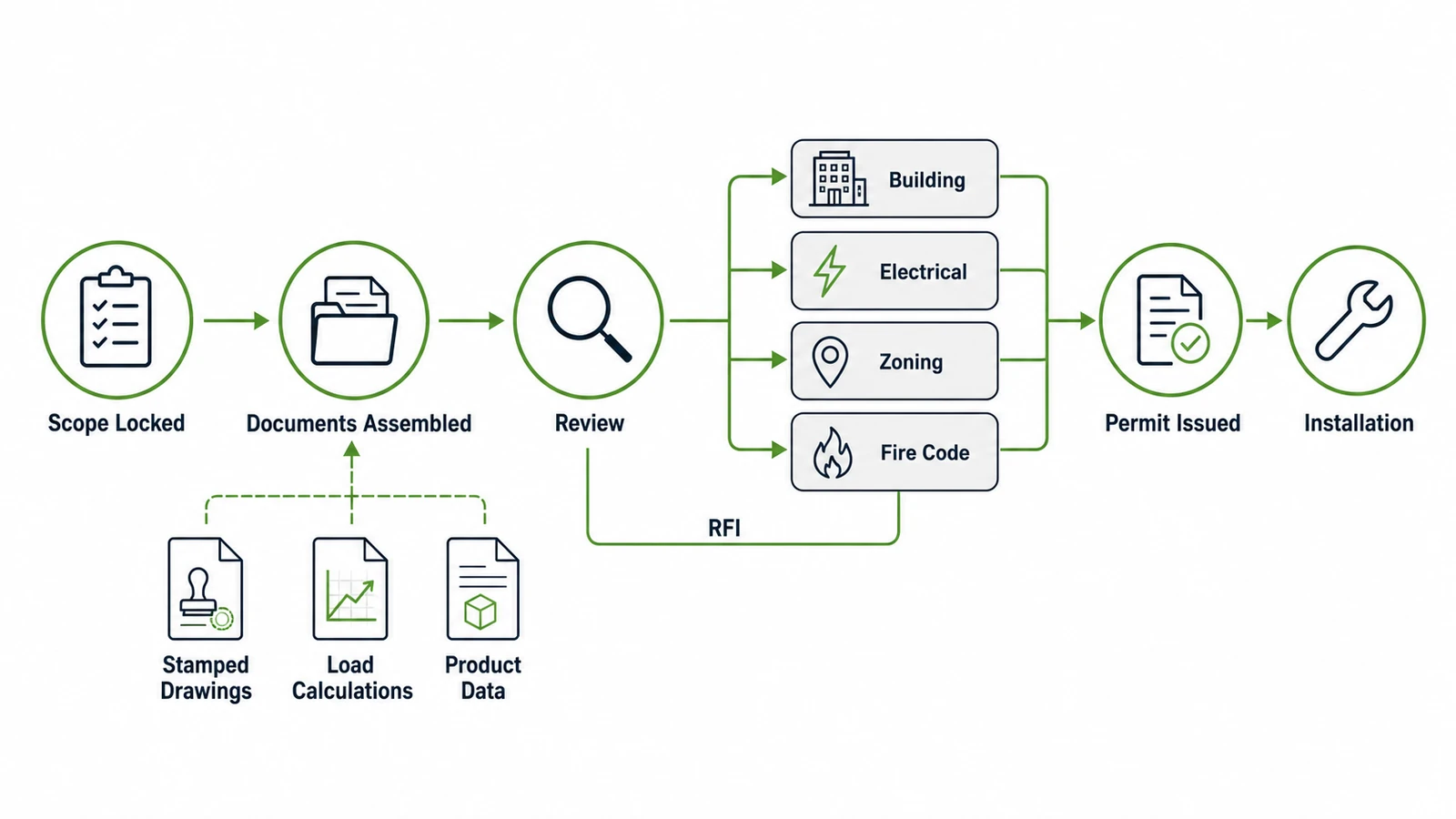
Commercial projects almost always trigger review, and the assumption that pergolas are exempt structures breaks down under commercial occupancy, public access and a large footprint.
A building permit for the structure. An electrical permit where there is lighting, a drive or controls. Zoning approval for setbacks and height. Attached structures usually need a permit whatever their size.
Restaurant and hotel terraces can also draw fire code review for egress and assembly occupancy, particularly where the structure sits next to an exit. That review runs on its own timetable and is the one most often discovered late.
What a plan check will ask for
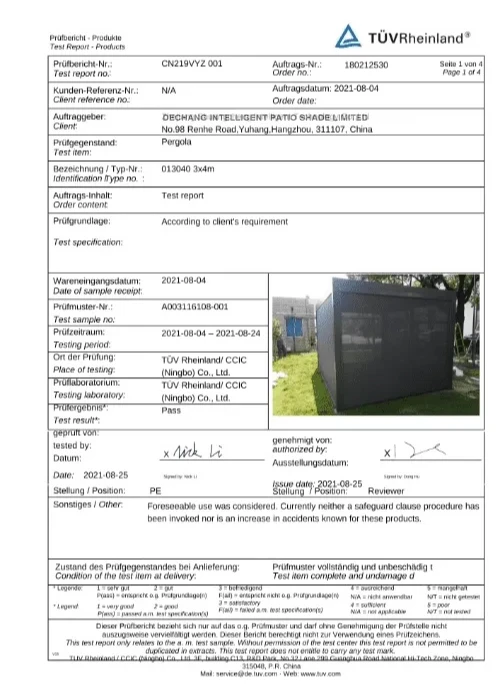
Four things attach to any wind or snow figure: the standard it was tested to, the testing body, the report reference, and the configuration covered. A number on a brochure without those four is a marketing claim.
alux tests to EN 13561 Class 6 under TÜV Rheinland, equivalent to Beaufort 9, under report CN25HMEF 001, and how those ratings are produced explains what each figure covers. Snow capacity runs 60 kg per square metre on the 100B series and 0.5 kN per square metre on the 100A series, each verified by TÜV loading tests on stated module sizes.
Beyond the load figures, most applications need engineer-stamped structural drawings, load calculations referenced to the governing code, anchor and footing details, and a product data sheet covering materials, coatings and hardware ratings. Ask whether the supplier provides that package as standard or treats it as a separate engineering engagement, because finding out mid-project costs your schedule and not theirs.
What certification does and does not do in the United States
Worth being precise here, because the point gets misstated often. CE and UKCA are conformity marks for the European and British markets. Neither carries legal standing in a US building department, and no American plan check accepts either in place of local compliance.
What they are useful for is evidence. A CE mark on the electrical package shows the drive and controls were assessed against a recognised safety standard. A TÜV Rheinland structural report gives a reviewing engineer real test data to work from. Both shorten the conversation without replacing it.
The compliance determination itself belongs to a licensed engineer working to local design values. Budget for that engagement at the outset, since the supplier’s paperwork does not close the question.
Certification set
alux holds CE for EMC and LVD through UDEM, UKCA to BS EN 60335 through BKC Testing, TÜV Rheinland structural testing, ISO 45001, and amfori BSCI for social compliance. Each traceable to a document you can request before an order, not after a dispute.
For a distributor the BSCI audit carries more weight than it looks. Buyers in several European markets now ask for it upstream, and a supplier without one narrows your customer list before you have quoted anybody.
Batch Consistency
The problem nobody raises until the second order arrives.
Colour
Powder coat batches vary, and the variation is small enough to pass inspection while still being visible. A structure installed in March next to one installed in October will show a difference if the batches differ and the colour was never locked. Put the RAL reference on the order, and get confirmation that the finish runs to that reference and not to a house standard that drifts.
On a phased project, ordering the whole colour requirement in one production run and storing the balance costs less than matching later.
Profile
Extrusion dies wear. A die replaced between orders produces profiles within tolerance but not identical, which matters where two structures sit side by side. Ask whether the die is dedicated and how old it is.
Hardware
Actuators get substituted quietly when a supply chain moves. So do gearboxes and fixings. Specify the drive by manufacturer and model on the order, and require notification before any substitution.
Freight and Packing
Freight is where distributor margin disappears, and it gets decided by how the product ships, not by the shipping line you use.
Knock-down against pre-assembled
Pre-assembled roof panels erect faster on site and occupy the air inside themselves for the whole voyage. Knock-down ships flat, which multiplies units per container and reduces damage in transit at the cost of site labour. What arrives in a kit sets out the contents and the exclusions.
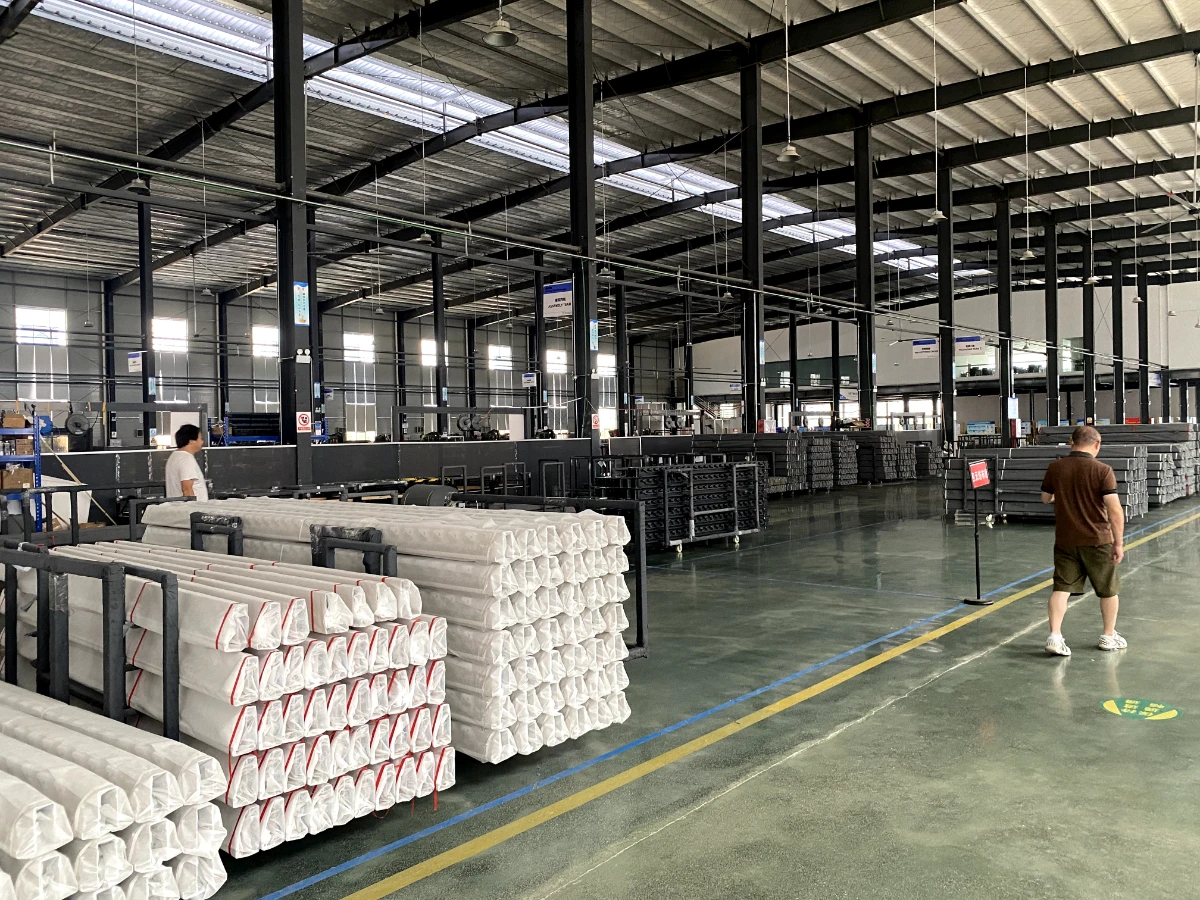
alux ships knock-down, which puts 40 to 50 sets in a 20GP and 115 to 135 in a 40HQ depending on model and configuration.
Run the arithmetic before comparing prices
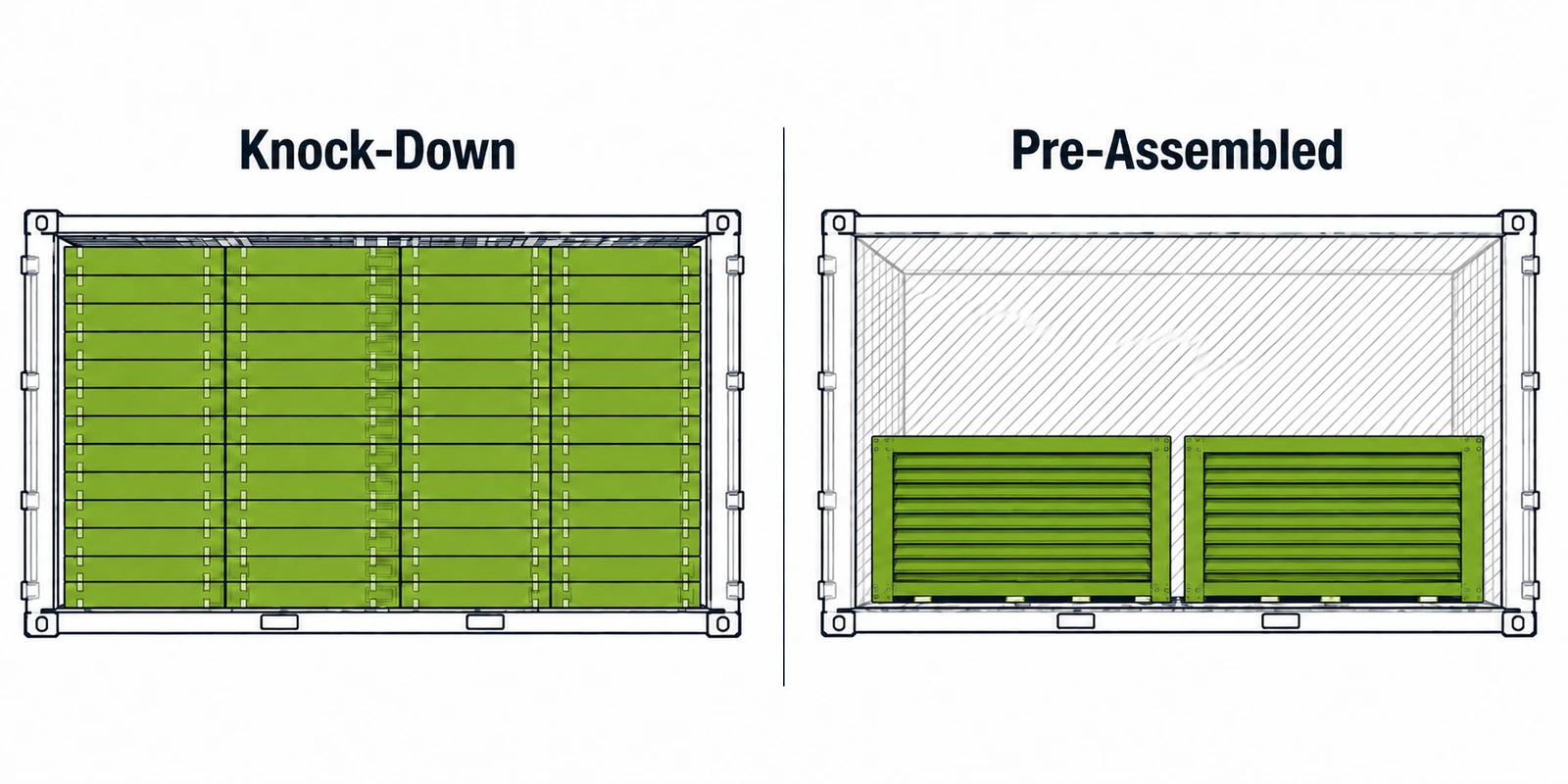
A supplier quoting ten percent less per unit while fitting thirty percent fewer units into a container is more expensive delivered. Ask for units per 20GP and per 40HQ at the exact configuration being quoted, not for the range.
Packing standard
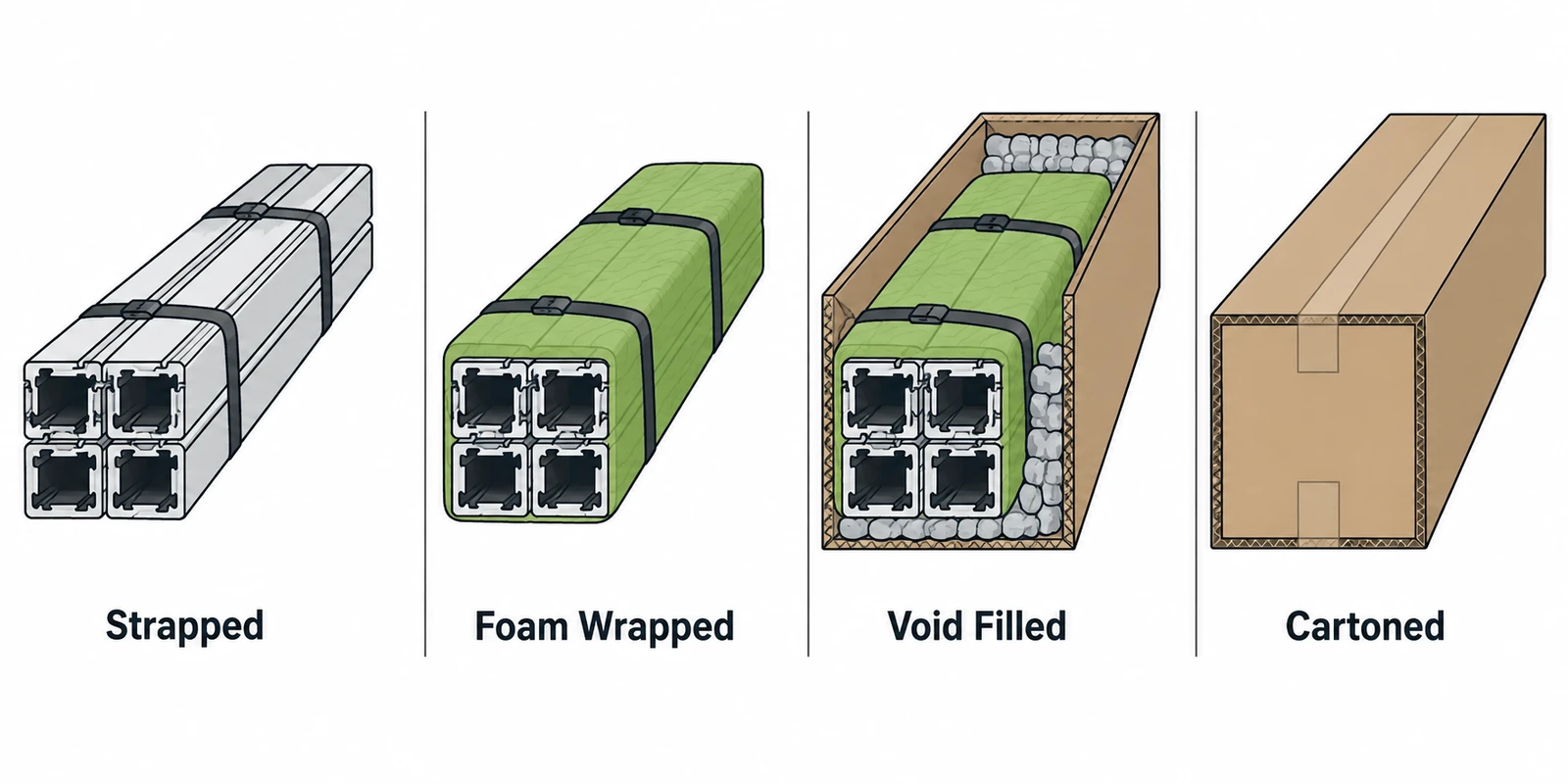
Profiles strapped into bundles so nothing moves against anything else, foam paper wrap on coated surfaces, void fill around the bundle, and a multi-ply corrugated carton around the assembly. Glass components belong in timber crates.
The strapping step is the one most often skipped and the one that prevents slow abrasion over six weeks at sea. A claim on ten damaged sets costs more than the packing on an entire container.
Lead Time and Phasing
Standard against large format
alux quotes 7 to 10 days for standard formats and 12 to 16 for larger ones. That is production time on the factory floor and nothing else.
Custom work sits outside those figures. Non-standard spans, a colour outside the standard range, or hardware specified by the project engineer all add scheduling ahead of production, and the honest question to any supplier is how long the queue is before the machine starts, not how long the machine takes.
Building the real programme
Add production. Inland haulage to port, sailing time, customs clearance, then inland delivery at destination. On a project with a fixed opening date, the float that matters is the one between arrival and installation, and it is the first thing compressed when anything upstream slips.
Phased delivery
Splitting a large order into two or three shipments reduces site storage and cash exposure, and it introduces the batch consistency problem described above. Where phasing is planned, lock colour and profile at the first order and hold the balance in the supplier’s production schedule, without reordering later.
What Actually Drives the Price
Two structures of the same footprint can differ substantially, and almost none of the difference is visible in a photograph.
The variables
Module size and how many modules the area divides into. Blade and post section. Coating thickness and the pretreatment under it. Whether the system is manual or powered, and how many drives the layout needs. Accessories: lighting, screens, heating, sensors. Drainage routing, since concealed discharge through the posts costs more than a perimeter outlet. And whether independent structural testing exists behind the load figures.
How to make quotations comparable
Normalise on those variables before comparing totals. A quotation that omits blade wall thickness and coating thickness is not comparable to one that states them, and the omission is rarely accidental.
Ask for the cost broken out
Ex-works price. Freight, duties and local installation, each quoted separately. A single delivered number hides which of the four a supplier is actually competitive on, and it makes the next order impossible to benchmark against this one.
Sampling
Order one before ordering forty
Minimum order at alux is one set, which makes a single unit practical to evaluate before committing to a programme. That unit answers questions no specification sheet can: how the finish looks in local daylight, how the roof sounds in rain, how long a crew takes over it, and whether the instructions are usable.
What to check on the sample
Coating thickness with a gauge, never by eye. Blade and post sections with calipers against the quoted figures. The full rotation range under load. Gutter discharge with a hose. And the fit of the meeting edges when closed, viewed from underneath in daylight.
After the Order
Spare parts
Actuators are the wearing component on a powered system, and manual versus motorized covers where each suits a project. Ask what is held in stock, the lead time on a single unit, and whether that model will still exist in five years.
Gaskets along the blade edge are the other consumable. They harden before they leak, so a supply held locally saves a call-out later.
Who installs it
On a project this gets decided late and should be settled early. A pre-drilled knock-down kit can be handled by a general crew, which widens the pool of people who can quote. What assembly actually involves gives a realistic view of the labour. A kit needing holes made on site cannot, because the accuracy of the finished frame then depends on whoever is holding the drill.
Documentation for the end client
On a commercial project the operator inherits the structure. A manual, a parts list with numbers, and the test documentation belong in the handover pack, and assembling that after the fact is harder than requesting it upfront.

Warranty terms
Read what is covered and for how long, and keep structural cover separate from finish cover in your head, because they usually run to different periods.
Installation error is excluded almost universally. That is one reason to keep the installation drawings and a set of photographs taken as the frame went up.
Running an RFP
A structured request does two jobs. It gives suppliers what they need to quote accurately, and the requirements themselves act as a filter.
What the document should contain
Project overview and site conditions. Structural and material specification, lifted from the spec sheet. Required certifications and compliance documentation. Production capacity and order quantity. Lead time expectation and delivery logistics. Warranty terms. After-sales and spare parts support.
Add one mandatory question asking how the supplier has handled compliance documentation on past projects in your jurisdiction. The answer tells you more than the brochure does.
Scoring the responses
Weight technical compliance with the specification heaviest, since it is the thing that either works or does not. Then documented experience at comparable scale, production capacity against your programme, and certification depth. Price and landed cost clarity carry the remainder.
A supplier returning a full documentation package, a broken-out price and references matching your scope belongs on the shortlist. One returning catalogue links and an invitation to schedule a call does not.
Questions to Send With an Enquiry
Sending these with the first email saves a fortnight of back and forth.
- The five specification figures, in writing.
- Wind and snow figures with standard, testing body, report reference and tested configuration.
- System weight per module, for the foundation calculation.
- Maximum clear span at the specified load case, and the deflection criterion it was calculated against.
- Coating standard referenced, alongside the thickness in microns.
- Whether engineer-stamped drawings and load calculations come as standard or as a separate engagement.
- Units per 20GP and per 40HQ at the quoted configuration.
- Production lead time for the quoted quantity, separate from freight.
- Whether the drive is specified by manufacturer and model, and whether substitution requires notification.
- Colour reference and whether the run can be held for a phased order.
- What ships with the unit and what is excluded.
- Spare parts availability and lead time.
- Certification documents available for review.
Key Points
- Project buyers and distributors want different things from the same supplier, and both need specification, contents and remedy confirmed in writing.
- Five figures make quotations comparable. Post section, blade section, coating thickness, rotation range, plus a load figure tied to a tested module size.
- CE and UKCA carry no legal standing in a US building department. They are evidence for an engineer, and the compliance determination still belongs to a licensed professional working to local design values.
- Batch consistency is the problem that surfaces on the second order, across colour, profile and hardware alike.
- Container density decides delivered cost more reliably than unit price does.
- A single sample unit answers questions no specification sheet can, and alux accepts a minimum order of one set.
Conclusion
Sourcing at project scale rewards asking narrow questions early. The specification figures make quotations comparable, the test documentation makes the permit possible, the container arithmetic makes the margin real, and a sample unit catches everything the paperwork missed. None of it takes long, and all of it is harder to fix once forty units are on the water.
Project specification, custom sizing and private-label programmes run through OEM and ODM. Certification documents are listed under certifications, production detail under our factory, and the current range on the louvered pergola page.
Frequently Asked Questions
What Should I Ask a Pergola Supplier Before a Large Order?
Five specification figures in writing: post section, blade section, coating thickness in microns with its pretreatment, rotation range as a number, and any wind or snow figure tied to the module size it was tested at. On a US project add five more: design wind pressure referenced to ASCE 7-16, snow load in psf, the deflection criterion, the coating standard called for, and system weight per module for the foundation calculation.
Do Commercial Pergolas Need a Permit?
Almost always. The assumption that pergolas are exempt structures breaks down under commercial occupancy, public access and a large footprint. Expect a building permit for the structure. An electrical permit where there is lighting or a drive. Zoning approval for setbacks and height. Restaurant and hotel terraces can also draw fire code review for egress and assembly occupancy.
Does CE Certification Count for a US Commercial Project?
Not as compliance. CE and UKCA are conformity marks for the European and British markets and carry no legal standing in a US building department. They are useful as evidence: a CE mark on the electrical package shows the drive was assessed against a recognised safety standard, and a TÜV Rheinland report gives a reviewing engineer real test data. The compliance determination still belongs to a licensed engineer working to local design values.
What Is the Lead Time on a Project Quantity?
Factory production runs 7 to 10 days on standard formats and 12 to 16 on larger ones. Custom spans, colours outside the standard range and engineer-specified hardware all add scheduling ahead of that, so the useful question is how long the queue runs before the machine starts. Ocean freight, customs clearance and inland delivery then sit on top of the whole thing.
How Many Pergolas Fit in a Container?
Entirely on whether it ships flat or pre-assembled. Flat-packed alux units load at 40 to 50 per 20GP and 115 to 135 per 40HQ, varying with model and configuration. Work out the delivered figure before comparing unit prices: a supplier ten percent cheaper per set that loads a third fewer sets per box costs more by the time it lands.
What Drives the Price Difference Between Suppliers?
Module size and count. Blade and post section. Coating thickness with its pretreatment. Whether the system is powered and how many drives the layout needs. Accessories. Drainage routing. And whether independent structural testing sits behind the load figures. Ask for ex-works price, freight, duties and local installation separately, since a single delivered number hides which of the four a supplier is competitive on.
What Goes Wrong on a Second Order?
Batch consistency. Powder coat batches vary within tolerance but visibly. Extrusion dies wear, so a replaced die produces profiles that are compliant without being identical. Drives and fixings get substituted quietly when a supply chain moves. Specify the drive by manufacturer and model. Put the RAL reference on the order. Require notification before any substitution.
What Should a Commercial RFP Contain?
Project overview and site conditions. The structural and material specification. Required certifications. Production capacity against order quantity. Lead time and delivery logistics. Warranty terms. After-sales support. Add one mandatory question asking how the supplier has handled compliance documentation on past projects in your jurisdiction, because the answer tells you more than the brochure does.