

The word kit covers two very different products. One arrives as a complete structure, cut and drilled, with nothing to source locally except the concrete. The other is a hardware set, where the box holds pivots and brackets and the buyer supplies the timber. Both are listed as louvered pergola kits, and the price gap between them tells you nothing until you know which one you are looking at.
The Three Kinds of Louvered Kit
Complete metal kits
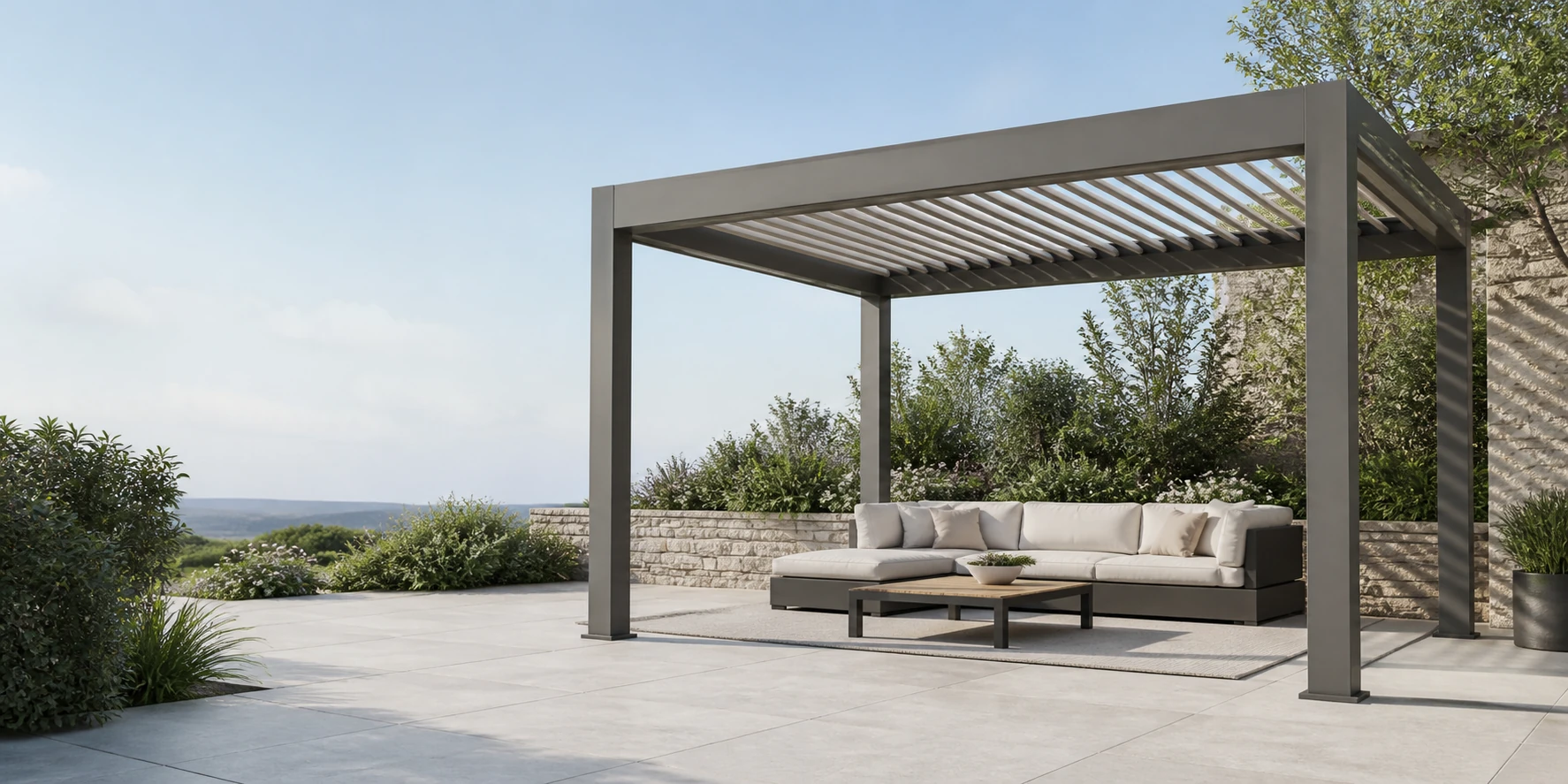
A complete aluminum or steel kit ships as a system. Posts, beams, louvers, linkage, fixings and instructions arrive together, every profile cut to length and drilled against a drawing. Assembly is bolting rather than building, and the manufacturer can state structural figures because it controlled every component in the box. If the mechanism itself is unfamiliar, what a pergola with a louvered roof is covers how the blades, linkage and drainage work together.
Timber kits
Wood kits arrive pre-cut and often pre-stained, with hardware included. Assembly takes longer than metal because timber has to be squared and adjusted on site, and boards vary enough between pieces that a drawing cannot fully anticipate the fit.
The blades themselves are the difference that shows up later. Timber moves with moisture, so a roof that closes cleanly in spring may bind in autumn, and the finish needs renewing on a cycle rather than lasting the life of the structure. Cedar and redwood are the usual choices because they are dimensionally stable and resist rot without treatment; treated pine is cheaper and more prone to warping in a component that has to rotate.
Louver hardware sets
A hardware set is the smallest of the three. It contains pivot hubs, mounting brackets and a manual pull rod, and the buyer buys the louver boards locally. These sets are usually sized for a single bay, commonly around a nominal eight by eight foot opening, and larger roofs are covered by dividing the area into sections rather than extending the run.
A hardware set carries no structural rating, no coating specification and no wind or snow certification, because the finished assembly depends on lumber the manufacturer never supplied. That is not a criticism of the product. It is the reason a hardware set costs a fraction of a complete kit, and the reason the two should never be compared on price alone.
Pre-Assembled or Knock-Down
Complete metal kits split again, and this is the choice that most affects a buyer holding stock.
Pre-assembled panels
Some kits arrive with the roof already built into panels that lock together on site. Erection is fast, and several brands compete directly on that figure, quoting roof assembly in minutes rather than hours for a standard module.
The trade-off is volume. A finished panel occupies the air inside itself for the whole voyage, which raises freight cost per unit and takes more warehouse space between orders. It also limits what can be changed: a panel is built to a size at the factory, so site adjustment is not an option if a measurement was wrong.
Knock-down flat pack
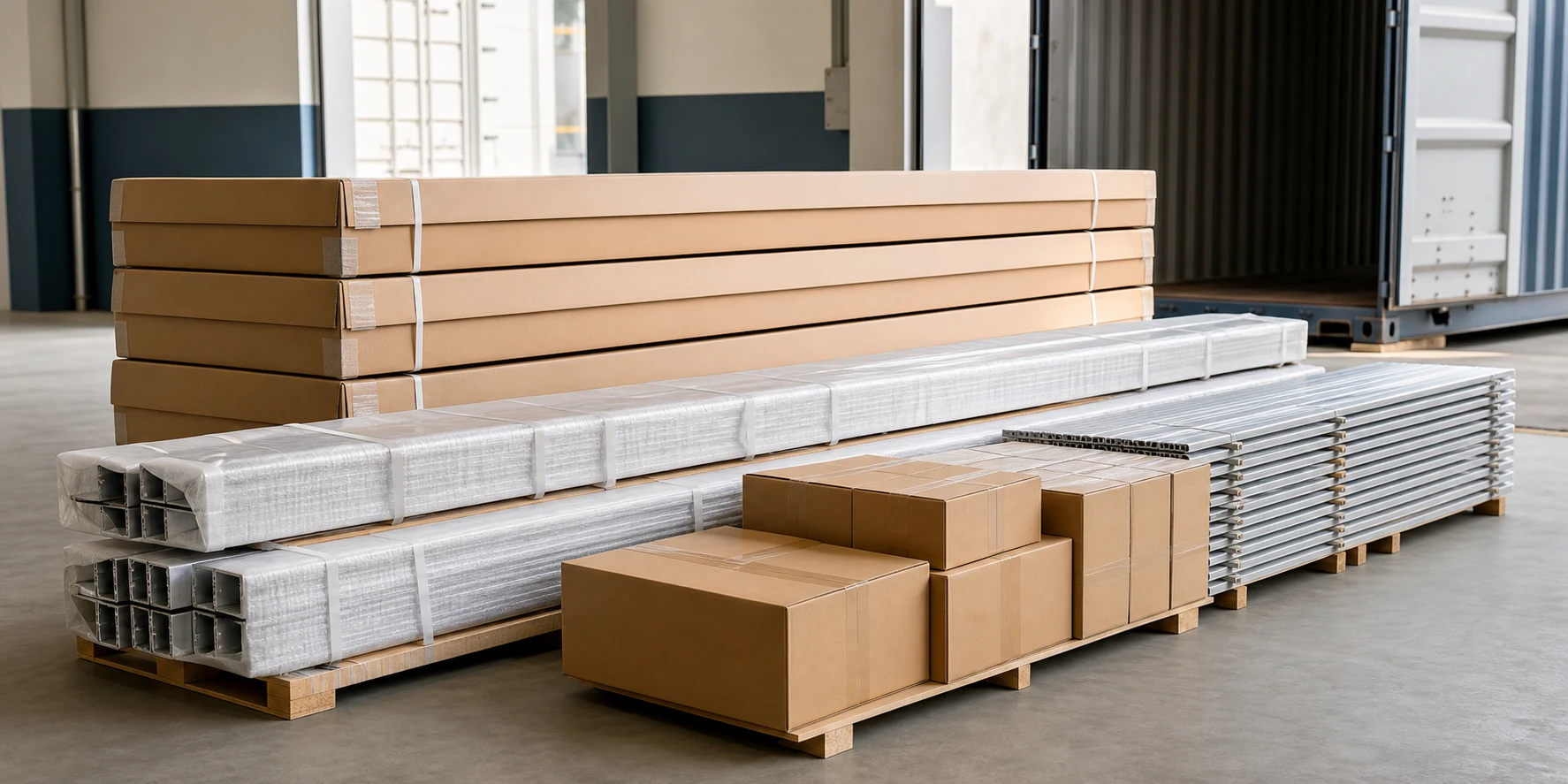
A knock-down kit ships flat and nested, with every bolt hole punched or drilled in the factory. Site work is longer because the frame is assembled from components rather than clicked together. What flat pack buys in return is freight density, lower damage rates in transit, and the ability to hold stock without dedicating a bay to every unit.
For an end user installing one structure, the pre-assembled route usually wins. For a distributor moving containers and holding inventory, the arithmetic runs the other way. alux ships knock-down for that reason, which is what puts 40 to 50 sets in a 20GP and 115 to 135 in a 40HQ.
What Is in the Cartons
The parts list
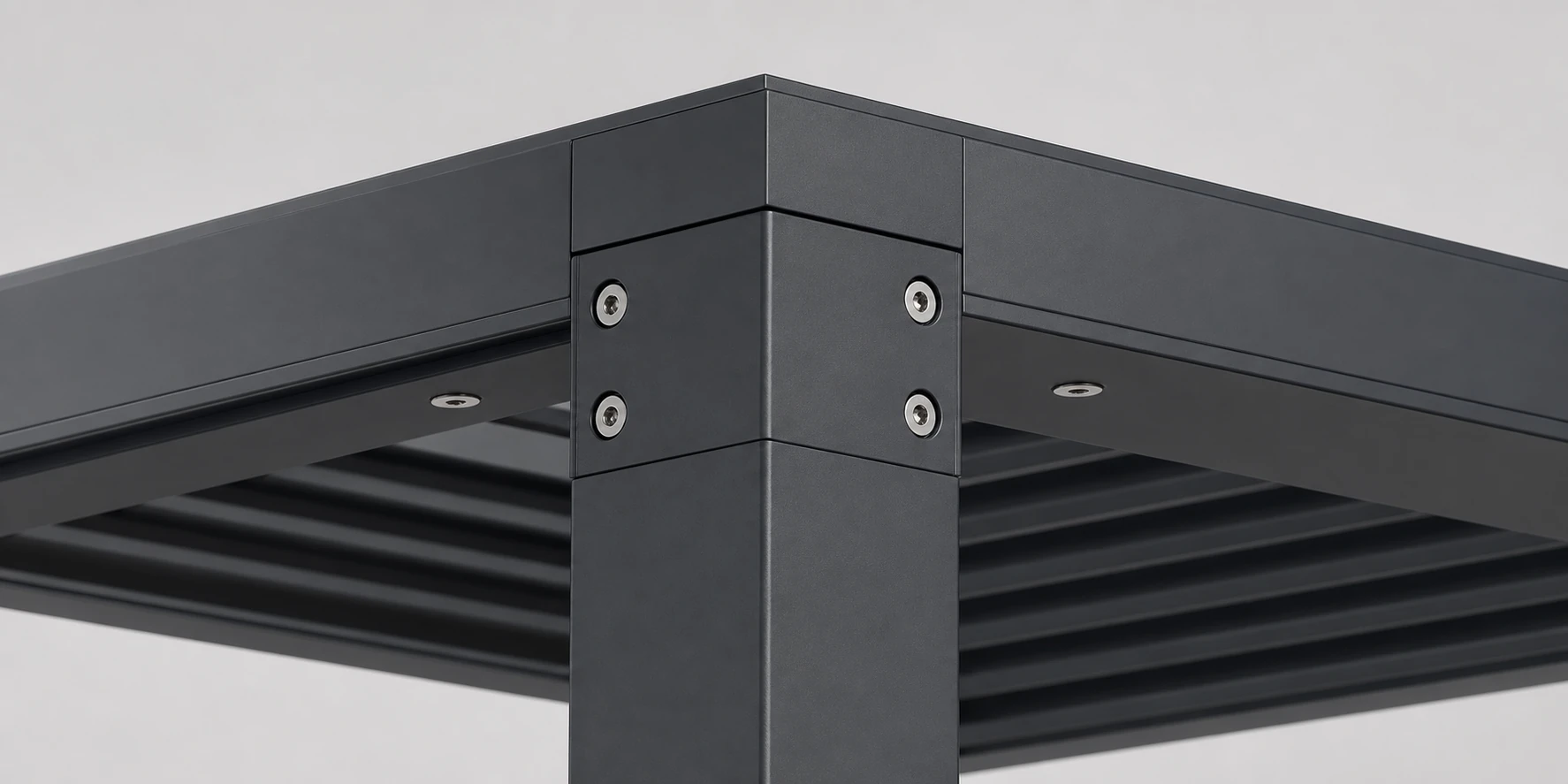
A complete louvered kit contains posts, perimeter beams with the gutter profile integrated, louver blades, the linkage bar that ties the blades together, end caps, base plates, the drive unit on motorized versions, fixings and an installation drawing. That list is broadly consistent across suppliers.
How the parts are protected
Packing is where suppliers differ, and it is easy to overlook when comparing quotations. A powder coated profile that rubs against another profile for six weeks at sea arrives with witness marks no buyer will accept, and a claim on ten sets costs more than the packing on a whole container.
What to look for is straightforward: multi-ply corrugated cartons rather than single wall, reinforced corners, foam or foam wrap on finished surfaces rather than bare contact, and void fill so profiles cannot shift. Glass components, where a configuration includes them, belong in timber crates rather than cartons.
The sequence matters as much as the materials. alux packs in four stages: profiles are strapped into bundles so nothing can move relative to anything else, each bundle is wrapped in foam paper to protect the coated surface, void fill goes in around the bundle, and the whole assembly ships inside a five-ply corrugated carton. Strapping before wrapping is the step most often skipped, and it is the one that prevents the slow abrasion that produces witness marks over a long voyage.
Carton count
Ask how many cartons a set breaks into before the first order. Fewer, longer cartons load more efficiently but need more people to move on site. More cartons handle easily but take more floor space in storage. Neither is better; they suit different operations.
The Four Specifications That Separate Kits
One listing reading aluminum louvered pergola can describe two kits whose wall thickness differs by half. These four figures are what tell them apart, and all four should be in writing before a price comparison means anything.
Section sizes
Post section and louver section determine what the structure carries. They are the specification most often left out of a listing.
A wider, deeper blade is stiffer over a longer span and overlaps more securely when closed, but it also weighs more, which loads the pivots and the drive harder over thousands of cycles. The section should be selected against the module size rather than chosen for its own sake.
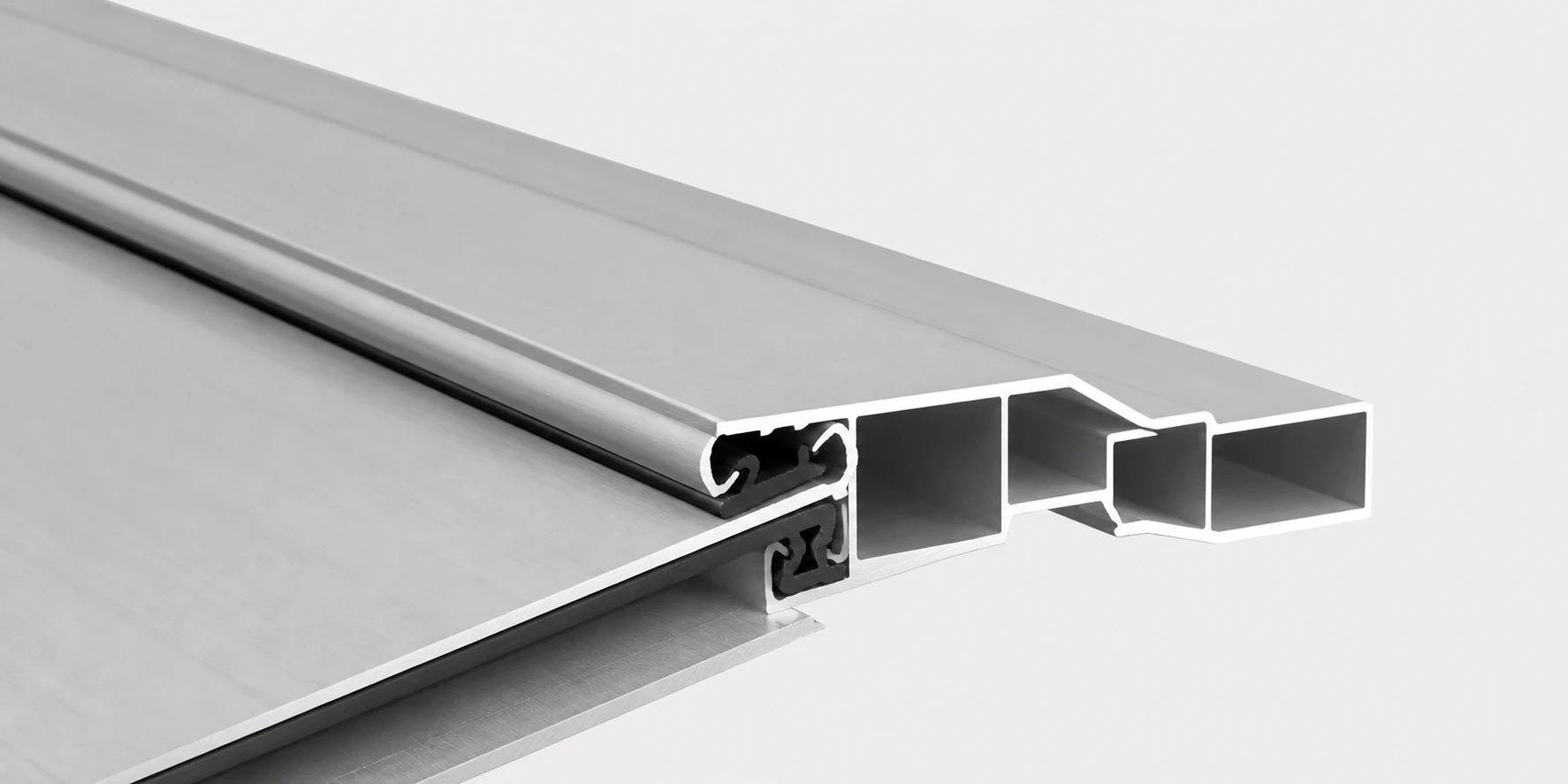
For reference, alux steel systems use a 100 by 100 mm post with blades from 123 by 19.8 mm on the ST-100-A to 150 by 34 mm on the ST-100-B-KD; the aluminum AL-120-A-KD uses a 120 by 120 mm post with a 158.8 by 34.7 mm blade in 6063-T5.
Coating thickness
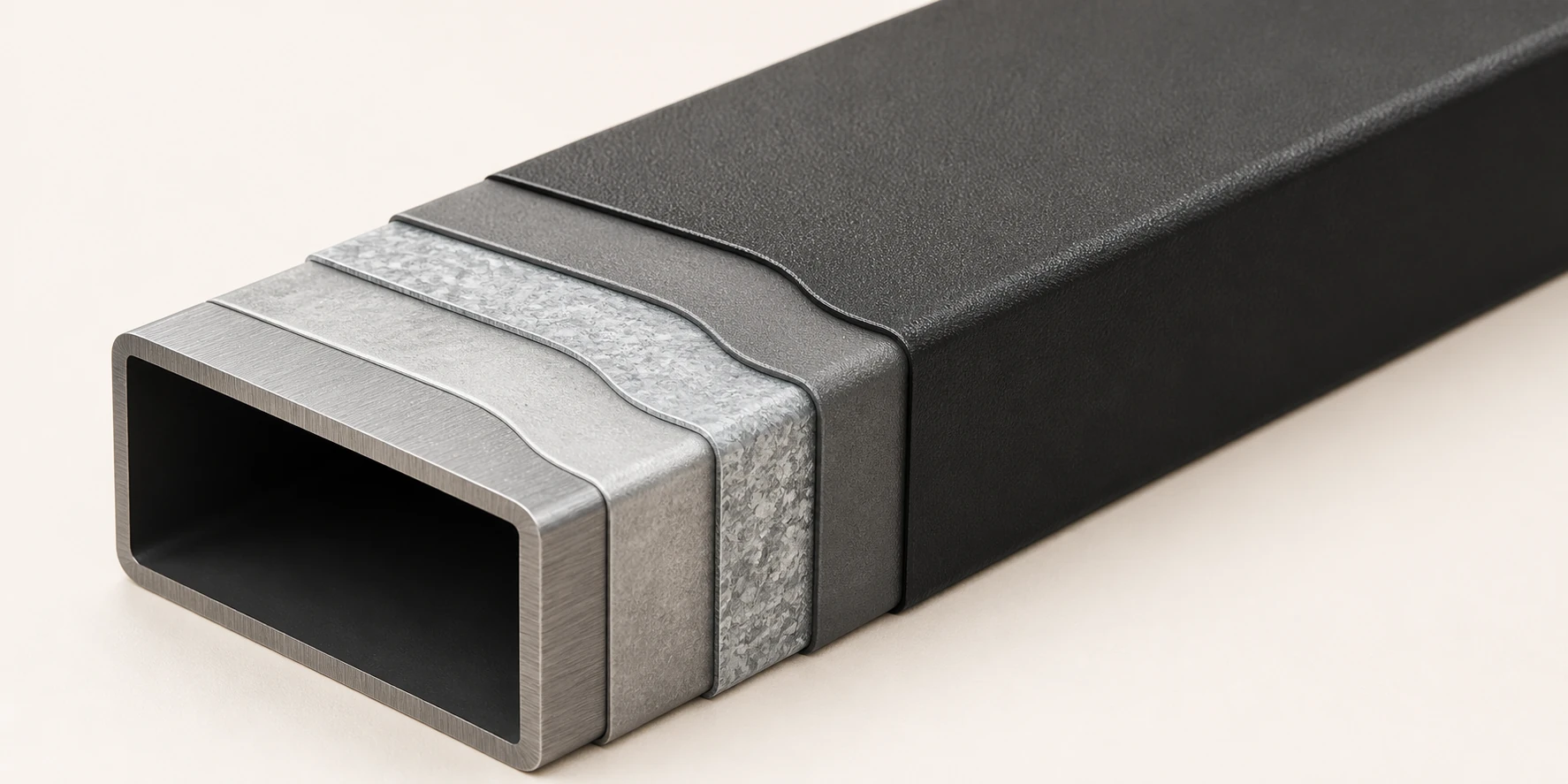
Every kit looks the same on the day it lands. Powder coated on its own describes a process, not a result, and 40 microns and 80 arrive looking identical before diverging somewhere around the fifth winter.
Ask for two things: thickness in microns, and the pretreatment before coating. A supplier who cannot state the thickness is either not measuring it or not controlling it.
Steel systems need one more question: what sits under the powder. Powder coating is a barrier, and once it is scratched, the base layer is what stops corrosion spreading under the film. Aluminum does not have this problem in the same way, which is part of why it commands a premium, though it is softer and marks more easily during handling. The full comparison is set out in steel pergola versus aluminum pergola. A kit listing rarely goes past the words powder coated. The alux steel range publishes what is under them: chemical passivation, a zinc-aluminum-magnesium base, then roughly 80 microns of powder, with 168 salt-spray hours and 100 UV hours recorded.
Drive rating
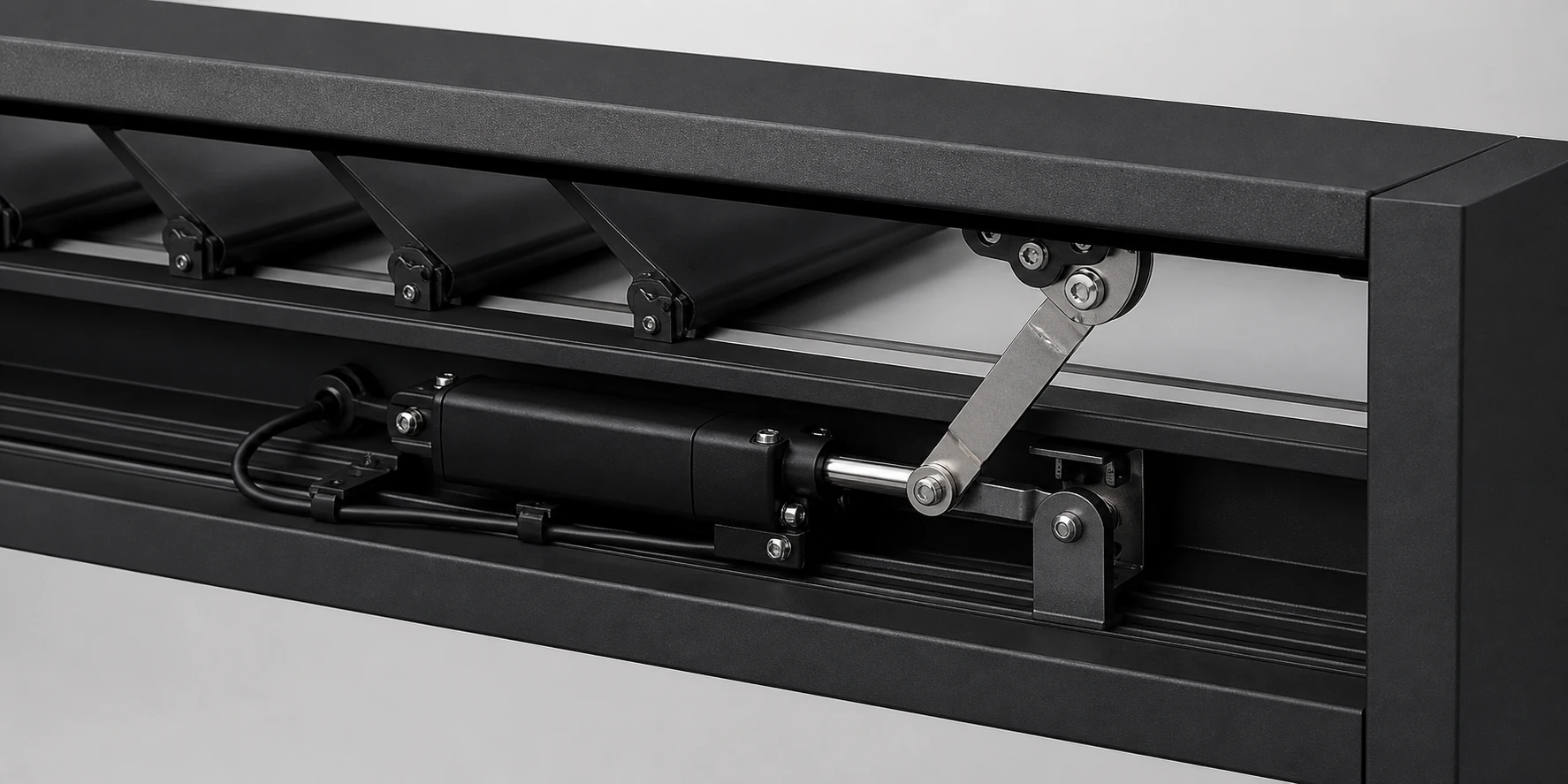
On a manual kit the linkage ends in a handle or pull rod and the specification ends there. On a motorized kit the drive decides service life.
Three numbers matter. Force, which has to suit the weight of the blade run. Stroke, which sets the rotation the roof achieves; a mismatch between stroke and blade geometry shows up as a roof that will not close fully rather than as an obvious fault. And ingress protection, which is the one most often omitted. The actuator is buried in the beam, which is the last cavity on the structure to dry out, so a splash-rated unit typically gives two seasons before it stops completing its travel, and the end it stops short of is the closed one.
Load rating with its configuration
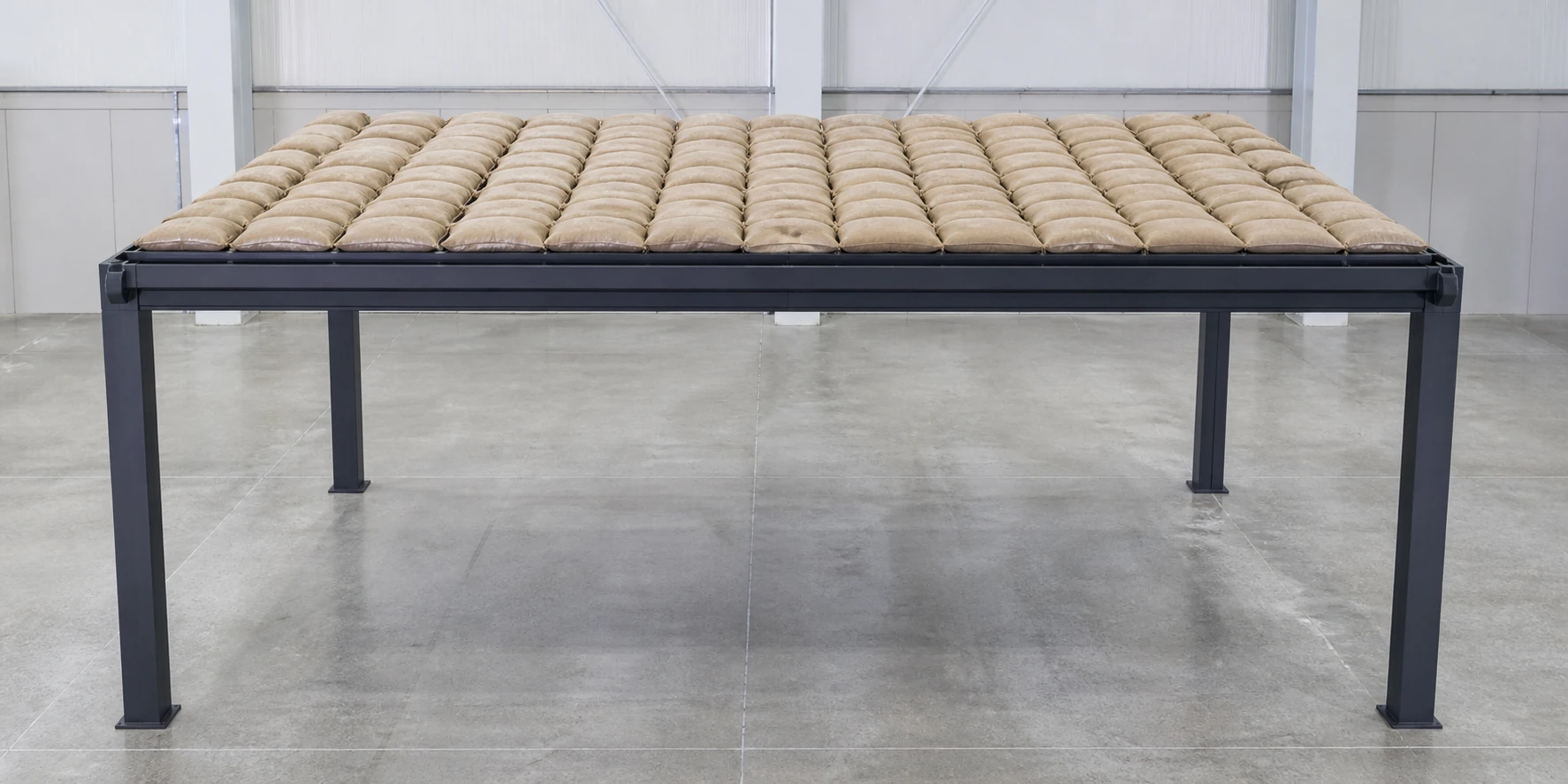
A wind or snow figure quoted without a size and a mounting condition is not a specification. Ratings belong to the module that was tested, and a larger module built from the same profiles does not inherit them.
Ask which standard, which size, and who issued the report. In Europe, external blinds and louvered roofs are commonly rated under EN 13561, which assigns wind classes to a tested configuration. A third-party report number is worth more than a figure on a specification sheet, because it can be requested and read.
Snow is the figure most often missing entirely, and it is the one that matters in any climate where the structure stays out through winter. It should be quoted as a load per square metre against a stated module size, not as a single number for a product family. How those figures are produced and what they mean on a real site is covered in pergola snow load and wind ratings explained. alux publishes EN 13561 Class 6 under TÜV Rheinland for wind, and snow figures tied to specific tested modules rather than to the range as a whole.
What Kits Usually Do Not Include
This is the section most listings avoid, and it is where installation delays come from.
Ground anchors
Commonly excluded, because the fixing depends on what the structure lands on. A concrete slab, a timber deck, a paved surface over compacted fill and a new footing each take a different anchor, and no manufacturer can supply one set that suits all four.
The drainage connection
The kit delivers water to the base of a post. Where it goes after that belongs to the paving falls or the drain on site, and it has to be planned before the frame goes up rather than after.
Electrical supply
Voltage, plug type and controller compatibility belong to the destination market and are confirmed before shipment rather than discovered on arrival. The kit ends at the controller; the supply to it is a site item.
Permits and sign-off
Where a local authority requires them, permits and engineering approval are the buyer’s or installer’s responsibility. The manufacturer’s role is to supply test documentation that supports the application, which is a reason to ask for report numbers rather than summary claims.
Consumables
Sealant and touch-up paint are cheap, needed on most installs, and rarely in the carton. A crew that discovers this on the day loses an afternoon.
Assembly: Time, People and Tools
Realistic timings
Published assembly times across the category range from a few hours to a full weekend. Aluminum kits with pre-drilled profiles sit at the fast end, timber kits at the slow end, because wood has to be cut and squared on site. Pre-assembled roof panels are faster still for the roof itself, though the base and posts take the same time either way.
What actually decides the time
Three things, none of them the kit. The base has to be level and square before anything is bolted, with matching diagonals. The post positions have to agree with the drainage plan, because reversing the discharge side after the frame is up is not a site adjustment. And on motorized kits the electrical connection has to be made and tested before the roof is loaded, not after.
People and tooling
Two people is the realistic minimum for a standard module. One can lay out and prepare, but lifting a beam into position alone is how finished profiles get scratched.
Tooling is modest: a spirit level, a socket set, a rubber mallet, string lines and a drill for the base anchors. A pre-drilled kit needs no cutting and no welding, which is what makes it viable for a dealer’s own crew rather than a specialist subcontractor.
Commercial Questions Before a First Order
Specification is half the decision. For anyone buying to resell, three commercial figures carry equal weight.
Minimum order quantity determines whether a single unit can be evaluated before committing. Container loading determines freight cost per set, and is a direct consequence of whether the kit ships flat or pre-assembled. Lead time determines whether stock can be replenished against demand or has to be forecast a season ahead.
alux answers those three with a minimum of one set, 40 to 50 sets per 20GP and 115 to 135 per 40HQ, and 7 to 10 days for standard formats extending to 12 to 16 for larger ones. Certification covers CE for EMC and LVD, UKCA to BS EN 60335, a TÜV Rheinland structural report, ISO 45001 and amfori BSCI, each traceable to a document rather than a catalogue sentence.
Conclusion
A louvered pergola kit is only as complete as its parts list, and the parts list is only as useful as the four specifications behind it. Establish which of the three kit types you are looking at, ask for section sizes, coating thickness, drive rating and load figures in writing, and confirm what is excluded before the crew arrives on site.
Current specifications are on the alux louvered pergola page, and custom sizes, finishes and private-label programmes run through OEM and ODM.
Frequently Asked Questions
What Are the Different Types of Louvered Pergola Kit?
Three. A complete metal kit ships posts, beams, louvers, linkage and fixings cut and drilled. A timber kit ships pre-cut wood with hardware. A louver hardware set ships pivots, brackets and a pull rod only, and the buyer sources the louver boards locally. Only the first two carry structural and coating specifications.
Should I Choose a Pre-Assembled or Knock-Down Kit?
It depends on whether the constraint is site labour or freight. Pre-assembled roof panels lock together quickly but ship at low density and cannot be adjusted on site. Knock-down kits take longer to erect but load far more units per container and store flat, which is why distributors generally prefer them.
What Is Usually Not Included in a Louvered Pergola Kit?
Ground anchors, the drainage connection below the post outlet, electrical supply to the controller, permits, and consumables such as sealant and touch-up paint. Anchors are excluded because a slab, a timber deck and a new footing each need a different fixing.
Which Specifications Should I Compare Between Suppliers?
Four: post and louver section sizes, coating thickness in microns with the pretreatment beneath it, drive force with stroke and IP rating, and any load figure quoted against the module size it was tested at. Two kits described identically can differ by half the wall thickness.
Why Does the Actuator IP Rating Matter?
Because the drive sits inside a beam cavity where condensation collects and drains slowly. A unit rated for splash rather than immersion typically runs two seasons before stalling at one end of its travel, usually in the closed position.
How Long Does a Louvered Pergola Kit Take to Assemble?
Published figures range from a few hours for pre-drilled aluminum to a full weekend for timber. What actually decides the time is site preparation: a level, square base with matching diagonals, post positions agreed with the drainage plan, and electrical connections tested before the roof is loaded.
Can Two People Install a Kit Without Specialist Tools?
For a standard module, yes. A spirit level, socket set, rubber mallet, string lines and a drill for the base anchors cover a pre-drilled kit, with no cutting or welding. One person can lay out and prepare, but a beam needs two sets of hands to lift without marking the finish.