

Short answer: The frame, blades, drainage and load rating are identical. Manual ends the linkage in a crank and gearbox; motorized ends it in a linear actuator. Manual suits small single modules, stable weather and sites without a power supply. Motorized suits large or multi-bay roofs, frequent adjustment, added screens or lighting, and any property where the roof needs to close while nobody is there. One constraint is easy to miss: the manual mechanism needs an accessible side, which usually limits enclosure to three sides rather than four.
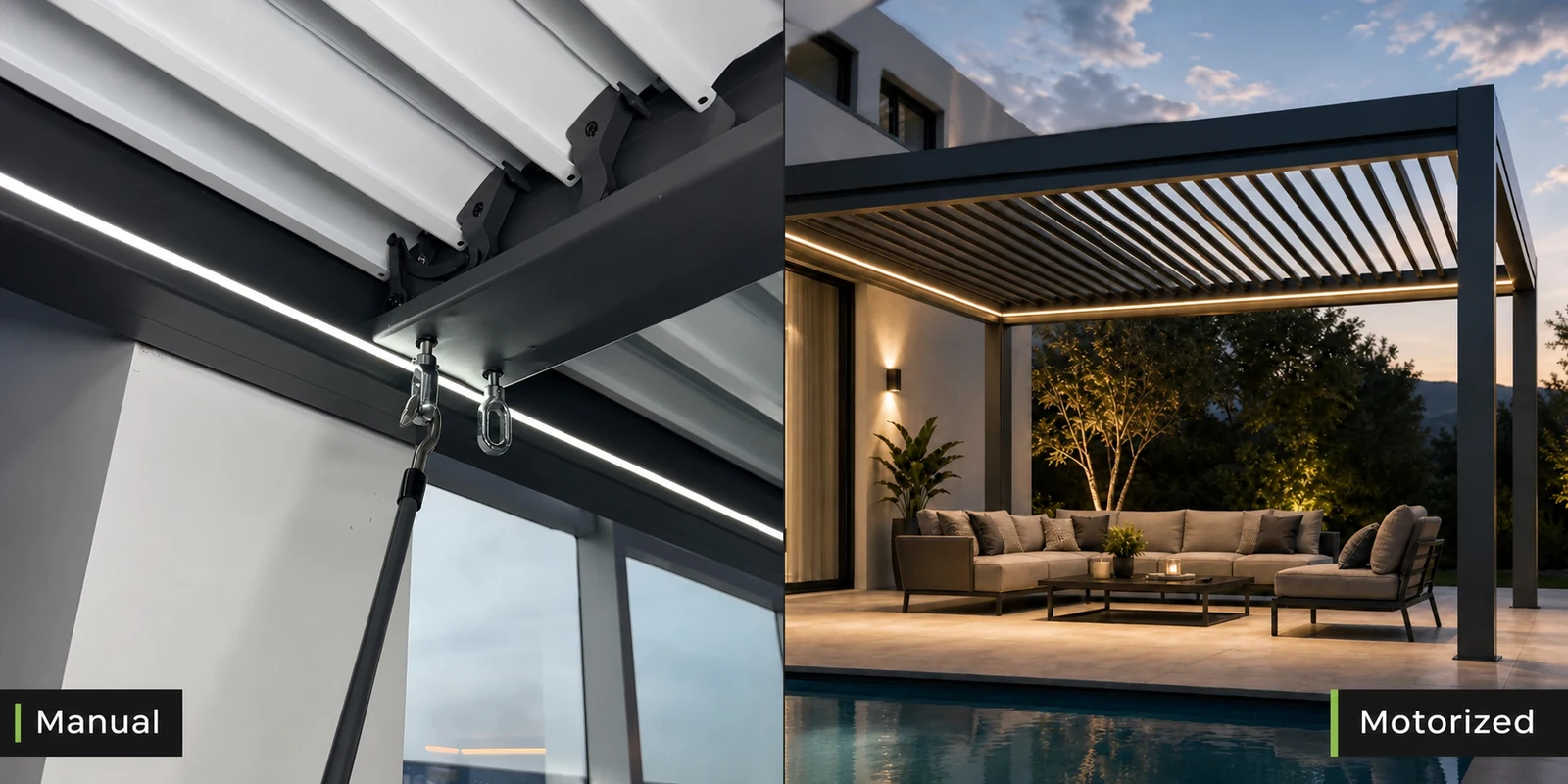
The frame is the same. The posts, beams, blades, gutter and coating on a manual louvered pergola are identical to those on a motorized one from the same range. What changes is how the blades are turned, and that single difference decides the installation, the accessories the structure can carry, the size it can reach, and what happens when the weather turns while nobody is outside.
What Actually Differs
The parts that are identical
Blade section, post section, span, drainage route, coating and load rating are properties of the structure, not of the control system. A manual roof from a given series sheds rain the same way and carries the same snow as its motorized equivalent. Any supplier who quotes different wind or snow figures for the two is describing a different structure, not a different control method. How those ratings are produced covers what the numbers refer to.
The part that changes
On a manual system the linkage bar terminates in a gearbox with a crank, a lever or a pull rod. On a motorized system it terminates in a linear actuator wired to a controller. Everything upstream of that termination is the same hardware.
alux builds both versions on one frame, at a 46,000 square metre site in Dexing, Jiangxi with 38,000 square metres under roof, shipping into 58 markets. Blade sections run 123 by 19.8 mm and 150 by 34 mm on the steel series and 158.8 by 34.7 mm on the aluminium AL-120-A-KD, with posts at 100 by 100 mm and 120 by 120 mm respectively. Because the structure is unchanged between the two, so are the figures behind it: EN 13561 Class 6 under TÜV Rheinland for wind, and 60 kg per square metre on the 100B series for snow.
How Manual Systems Work
The mechanism
A worm gearbox or ratchet converts crank rotation into linear travel along the operating bar, which rotates every blade in the run together. The mechanism behind a louvered roof is the same in both versions. The gearing is what makes it manageable: without reduction, turning twenty blades against their own weight would take more force than a hand can apply comfortably.
That reduction has a cost in time. A full sweep from open to closed typically takes a number of turns rather than a single motion, and the more reduction a system uses to keep the handle light, the more turns it needs. Light and quick are opposing requirements in a manual gearbox, and a system that feels effortless in a showroom may be the one that takes longest in the rain.
Where the hardware shows
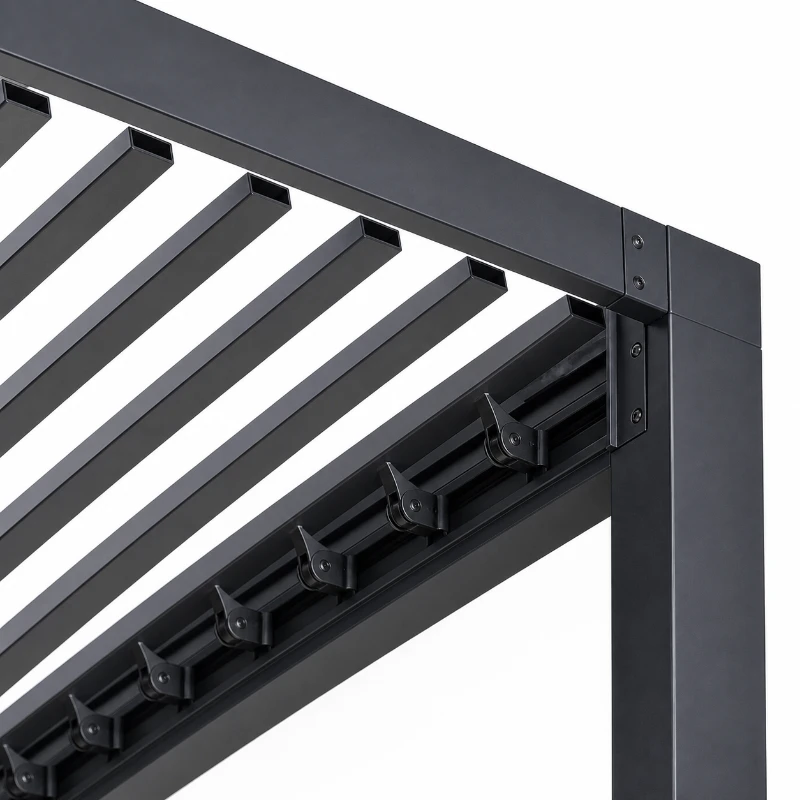
Manual mechanisms are more visible than motorized ones. The gearbox, the crank socket and sometimes the linkage sit where they can be reached, which is the point. Motorized drives are concealed inside the beam, so the structure reads cleaner. For some buyers the exposed mechanism is honest engineering; for others it is a detail they would rather not see. It is worth looking at both in person rather than deciding from renders.
Effort rises with size
Force at the handle scales with the number of blades and their length. On a small module over a doorway or a compact patio the effort is trivial. On a large or double-bay roof it becomes a real chore, and the point at which it stops being acceptable arrives sooner than most buyers expect.
Height compounds this. A crank at 2.4 metres is reachable; the same crank on a roof set higher, or on a wall-mounted structure at first-floor level, is not.
One side has to stay accessible
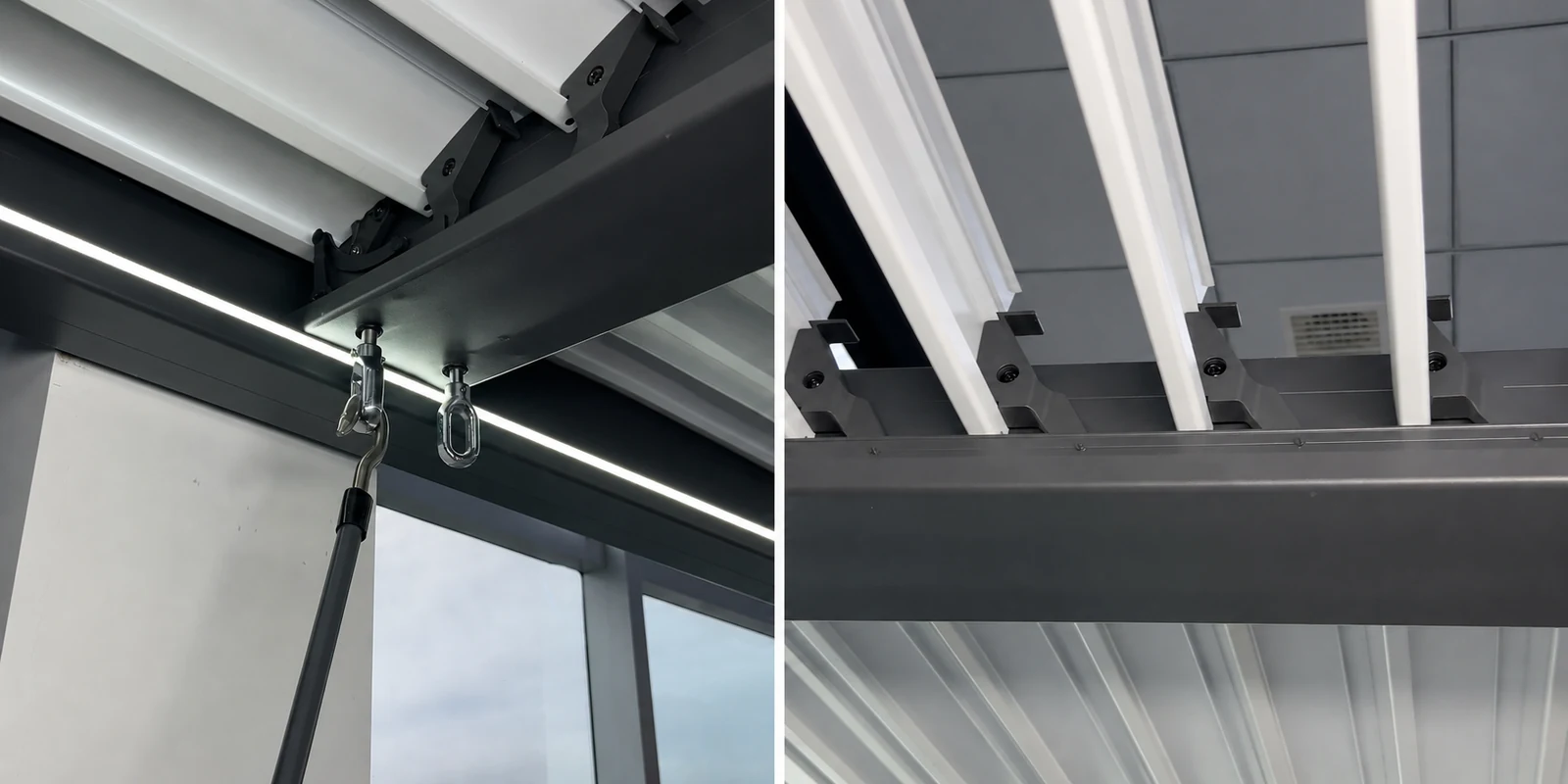
This constraint is rarely mentioned and matters more than the effort. The gearbox and crank sit on one side of the structure, and that side has to remain reachable. In practice it means a manual roof can usually take privacy shutters, screens or glazing on three sides rather than four.
Anyone planning a fully enclosed outdoor room should settle this before choosing manual, because the constraint is set by where the mechanism lives and cannot be designed around afterwards.
What manual gives back
No electrical specification to match to a destination market. No controller to become obsolete. Nothing to fail in a power cut, in a remote location, or on a site where running a supply would mean trenching across finished paving. Fewer components in the chain means fewer things that can stop working, and the ones that can are mechanical and repairable rather than electronic and replaceable.
For a distributor there is a further consideration. A manual unit has no electrical package to certify against a destination market, which removes a step from importing and a category of after-sales problem from stock that sits in a warehouse before it sells.
How Motorized Systems Work
The drive
A linear actuator mounted inside the beam cavity extends and retracts to move the operating bar. alux uses a Hongze unit at 28 mm diameter, 24V DC and 24W, rated 600N, travelling at 4 mm per second, with stroke selected against blade width to reach the full 0 to 180 degree range.
Why the ingress rating decides service life
The actuator sits in a beam cavity where condensation collects and drains slowly. A unit rated for splash rather than immersion will run for two seasons and then begin stalling at one end of its travel, usually in the closed position, which is when the roof is most needed. alux specifies IP67 for that reason.
Motor brand is worth asking about for the same reason. A named manufacturer can be checked, has spare parts, and has a published rating. Where the drive sits among the other opening mechanisms is covered in roofs that open. An unnamed generic has none of those things, and it is the component most likely to need replacing before the structure does.
Controls
At minimum a wall switch or handheld remote. Above that, smartphone control over Wi-Fi or Bluetooth, and at the top end integration with home automation platforms and programmable scenes. On larger roofs divided into modules, each module has its own drive, so zones can sit at different angles.
One specification separates a controller that works from one that mostly works: whether communication runs both ways. A one-way remote sends a command and hopes. A bidirectional system confirms the roof received it and reports its actual position, which is what makes scheduling and sensor automation reliable rather than approximate.
Sensors
Rain and wind sensors close the roof without anyone present. This is the argument for motorization that manual cannot answer at any price: a roof that closes itself protects furniture on a restaurant terrace nobody is standing on.
Worth asking what the sensor actually does at the limit, and how long it takes. A roof that begins closing when the first drops land is only useful if the travel completes before the shower does.
Manual override
Ask what happens in a power cut. Better systems include a crank or release that lets the roof be moved by hand. Without one, a roof caught open stays open until the supply returns. Battery backup is usually an option rather than standard.
The failure mode is worth understanding rather than assuming. Most actuators hold their last position when power is lost, which is structurally safe: the roof does not fall open or slam shut. What it does mean is that the position the roof happened to be in becomes the position it stays in, which is fine at closed and unhelpful at open.
Accessory integration
Once a supply runs to the frame, lighting, heaters and motorized screens share the same route. alux side screens use a separate tubular motor rather than sharing the roof drive, and run to 4,000 by 3,000 mm on the W100 and 5,500 by 3,000 mm on the W125, tested at 102 km per hour. Adding any of these to a manual structure later means running conduit after the frame is up.
| Criterion | Manual | Motorized |
|---|---|---|
| Structure and load rating | Identical | Identical |
| Actuation | Crank into a worm gearbox | Linear actuator in the beam cavity |
| Practical size | Single module | Single or multi-bay |
| Enclosed sides | Usually three | Four |
| Electrical work | None | Licensed supply, often a permit |
| Closes when nobody is present | No | With sensors, yes |
| Zoning across modules | Separate cranks | Grouped or independent |
| Behaviour in a power cut | Unaffected | Holds last position |
| Accessory integration | Conduit added later | Shares the existing route |
| Annual maintenance | Gutters, pivots, fixings | Gutters, pivots, fixings |
Cost
The premium for motorization is commonly quoted across the market at roughly twenty to fifty per cent of the system price, but that figure understates the installed difference.
The motor is the smaller part of it. The rest is the controller, the wiring, a licensed electrician to run the supply, and in many jurisdictions an electrical inspection on top of the structural permit. Published figures for the installed gap between equivalent manual and motorized systems commonly run into the low thousands once labour and permitting are counted.
Against that, motorization removes nothing from the running cost. Both systems need the same gutter clearing and the same annual check of pivots and fixings, and both drain the same way, with the same limits when rain arrives sideways.
Choosing Between Them
By size
Small single modules: manual works comfortably. Large or multi-bay roofs: motorized, because the effort and the number of separate cranks both become unreasonable.
By how often the roof will move
A roof set once for a season and left is a manual roof. A roof that should follow the sun through an afternoon will not get adjusted by hand as often as it should, and an adjustment that does not happen is worth nothing regardless of what the mechanism cost.
By climate
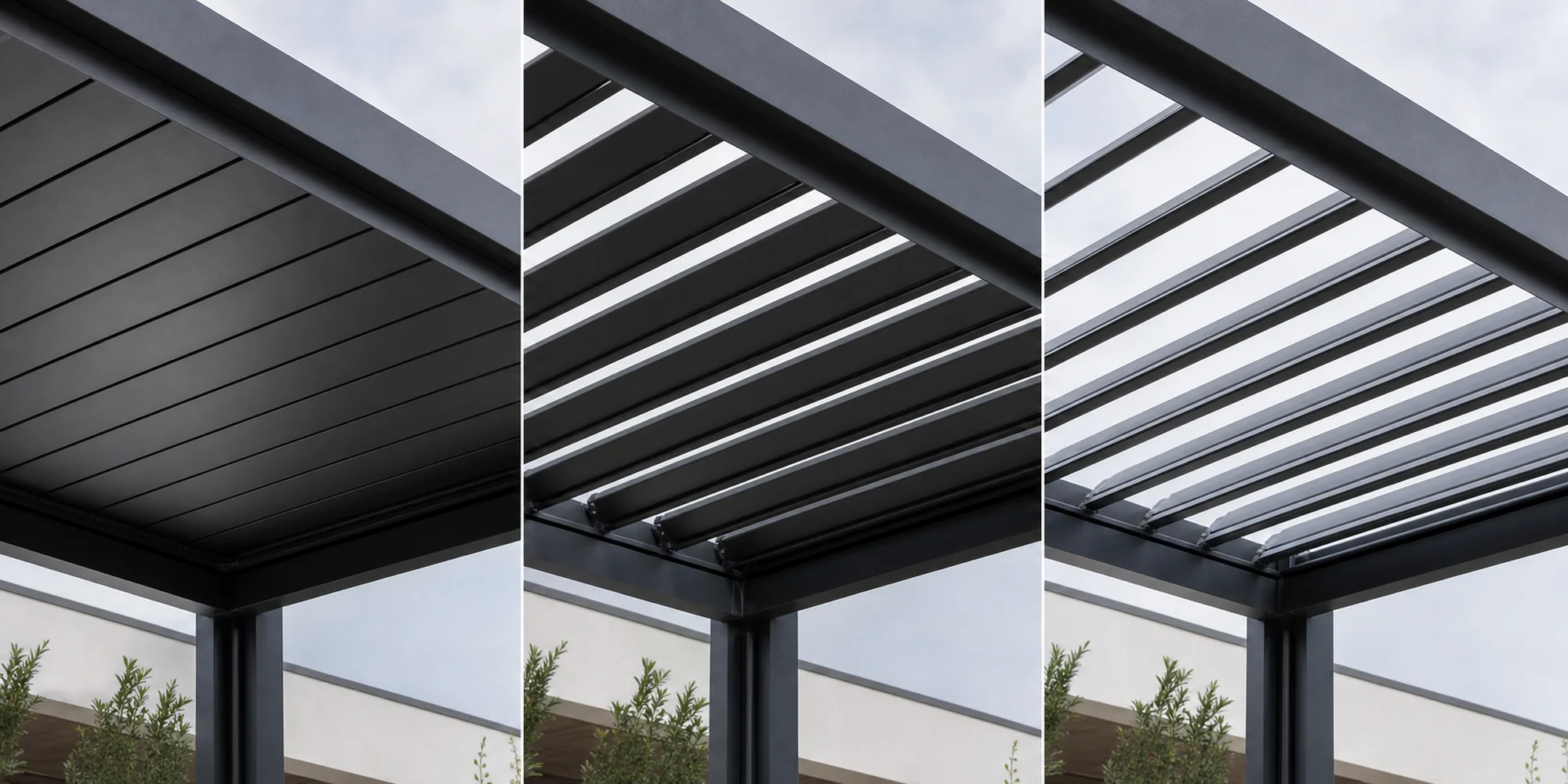
Where weather changes quickly during the day, sensors earn their price. Where the pattern is stable and predictable, they matter much less.
Winter behaviour is the part people forget. A roof left open through a wet season collects leaves in the gutter and gives wind more surface to catch, so it should be closed between uses. On a manual system that is a trip outside; on a motorized one it is a schedule.
By what else goes on the structure
Screens, lighting and heaters all want power at the frame. If any of those are planned, the supply is being run anyway and the marginal cost of motorizing the roof drops. If the roof is the only powered element, that supply exists solely for it.
The three-sided constraint applies here too: a manual roof plus full perimeter enclosure is not a combination most systems can deliver.
By site
No supply and no practical route for one points to manual. So does a holiday property where the power is switched off between visits, unless the roof can be left closed.
Accessibility is the other site factor. Where a user has limited mobility or reach, a crank at height is not a minor inconvenience but the difference between a roof that gets used and one that stays wherever it was last set.
Upgrading Later
Some manufacturers pre-install the mounting points for an actuator on manual units, so the drive can be added later without dismantling the roof. Where that is offered it is worth taking, because the alternative is replacing the gearbox end of the structure.
If a later upgrade is even a possibility, run a conduit to the relevant post during installation while the ground is open. The cabling costs little at that stage and a great deal afterwards.
What to Confirm Before Ordering
- Which side the manual mechanism sits on, and whether that side is one you wanted to enclose.
- The actuator brand, its force rating and its ingress protection class.
- Whether a manual override or battery backup is included or extra.
- Voltage, plug type and controller compatibility for the destination market.
- Whether the frame is pre-drilled for a later motor retrofit.
- And, on both systems, blade and post section, coating thickness, and a wind or snow figure tied to the module size that was tested. Material choice is a separate question, covered in steel versus aluminum.
Key Points
- Structure, drainage and load rating are identical between manual and motorized versions of the same series. Only the termination of the linkage changes.
- Manual effort rises with blade count and length, and with mounting height.
- A manual mechanism requires one side of the structure to stay accessible, which usually limits enclosure to three sides.
- Motorization is the only way a roof closes when nobody is present, which is the argument sensors answer and manual cannot.
- Ingress rating and motor brand predict service life better than headline force figures.
- The motorized premium is mostly controller, wiring, electrician and permit rather than the motor itself.
Conclusion
Neither system is better in the abstract. Manual suits small roofs, stable climates, sites without a practical power route, and buyers who value a mechanism with nothing electronic in it. Motorized suits large roofs, changeable weather, structures carrying screens and lighting, and anyone who wants the roof to respond when the terrace is empty.
The question worth asking is not which is better but how often the roof will actually be moved, and whether it needs to move when nobody is there to move it.
Both versions of the alux range are on the louvered pergola page, with the powered configurations detailed under motorized pergola. Dealer and private-label programmes run through OEM and ODM.
Frequently Asked Questions
What Is the Difference Between a Manual and a Motorized Louvered Pergola?
Only how the blades are turned. Both use the same posts, beams, blade sections, drainage route and coating, so both carry the same wind and snow rating. A manual system ends the operating bar in a worm gearbox with a crank; a motorized system ends it in a linear actuator wired to a controller. Everything upstream of that termination is identical hardware.
Is a Manual Louvered Pergola Hard to Operate?
On a single module, no. The gearbox reduces the effort so the handle turns easily, at the cost of taking several turns for a full sweep. Effort rises with blade count, blade section and mounting height, so the question is not whether it is hard but at what size it stops being incidental. Turn the handle on the size you intend to buy rather than relying on a published maximum.
Can a Manual Pergola Have Screens on All Four Sides?
Usually not. The gearbox and crank sit on one side and that side has to stay reachable, which typically caps privacy shutters, screens or glazing at three sides. Anyone planning a fully enclosed outdoor room should settle this before choosing manual, because it is set by where the mechanism lives and cannot be designed around afterwards.
How Much More Does a Motorized Pergola Cost?
The premium on the structure is commonly quoted at roughly twenty to fifty per cent, but that understates the installed difference. The motor is the smaller part: the rest is the controller, wiring, a licensed electrician and often an electrical inspection on top of the structural permit. Running costs afterwards are the same, since both need the same gutter clearing and annual check of pivots and fixings.
What Happens to a Motorized Roof in a Power Cut?
Most actuators hold their last position, which is structurally safe but means a roof caught open stays open until the supply returns. Better systems include a crank or release for manual operation; battery backup is normally an option rather than standard. Ask which applies before ordering.
Which Actuator Specifications Should I Check?
Force, stroke and ingress protection, with IP67 as the sensible outdoor minimum because the drive sits in a beam cavity where condensation collects and drains slowly. Motor origin matters as much: a named manufacturer can be checked and has spare parts. alux uses a Hongze unit at 28 mm diameter, 24V DC, rated 600N at IP67.
Do Rain and Wind Sensors Justify Motorization?
On a property that is not permanently occupied, they are the argument manual cannot answer at any price, because a roof that closes itself protects furniture on a terrace nobody is standing on. Worth asking what the sensor does at its limit and how long the travel takes, since a roof that starts closing at the first drops is only useful if it finishes before the shower does.
Can a Manual Pergola Be Motorized Later?
Sometimes. Some manufacturers pre-install the actuator mounting points on manual units so a drive can be added without dismantling the roof. Where that is not offered, retrofitting means replacing the gearbox end. If a later upgrade is even possible, run conduit to the relevant post during installation while the ground is still open.