

Short answer: Covered pergolas sit on a spectrum. Open rafters and shade fabrics mainly control sunlight. Weather-rated retractable fabrics may also manage rain within their stated pitch and wind limits. Closed louvered roofs and fixed panels collect and drain vertical rain, while open sides still admit low sun, wind and wind-driven rain. Side screens extend protection, but full enclosure also changes ventilation and may affect local approval requirements.
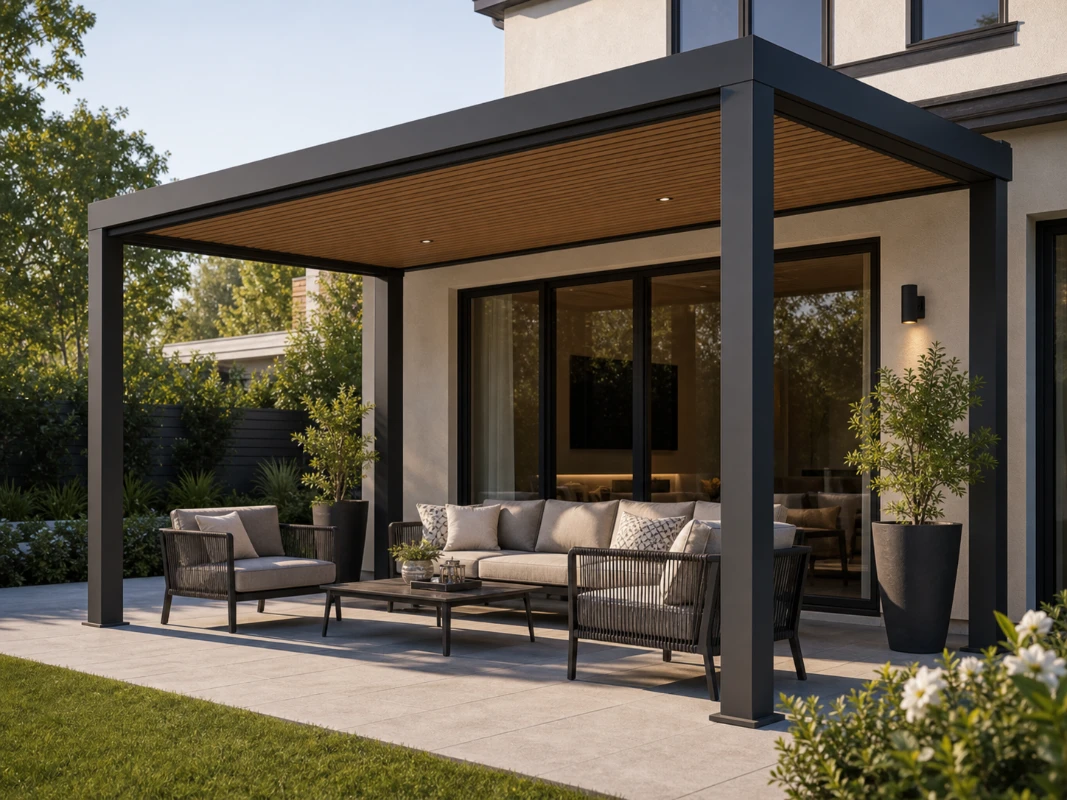
Product listings use covered for everything from fabric over open rafters to a roof with glazed walls. Those products do not offer the same protection. A useful comparison asks three questions: covered against what, under which conditions, and where does the protection stop?
Covered Is a Spectrum
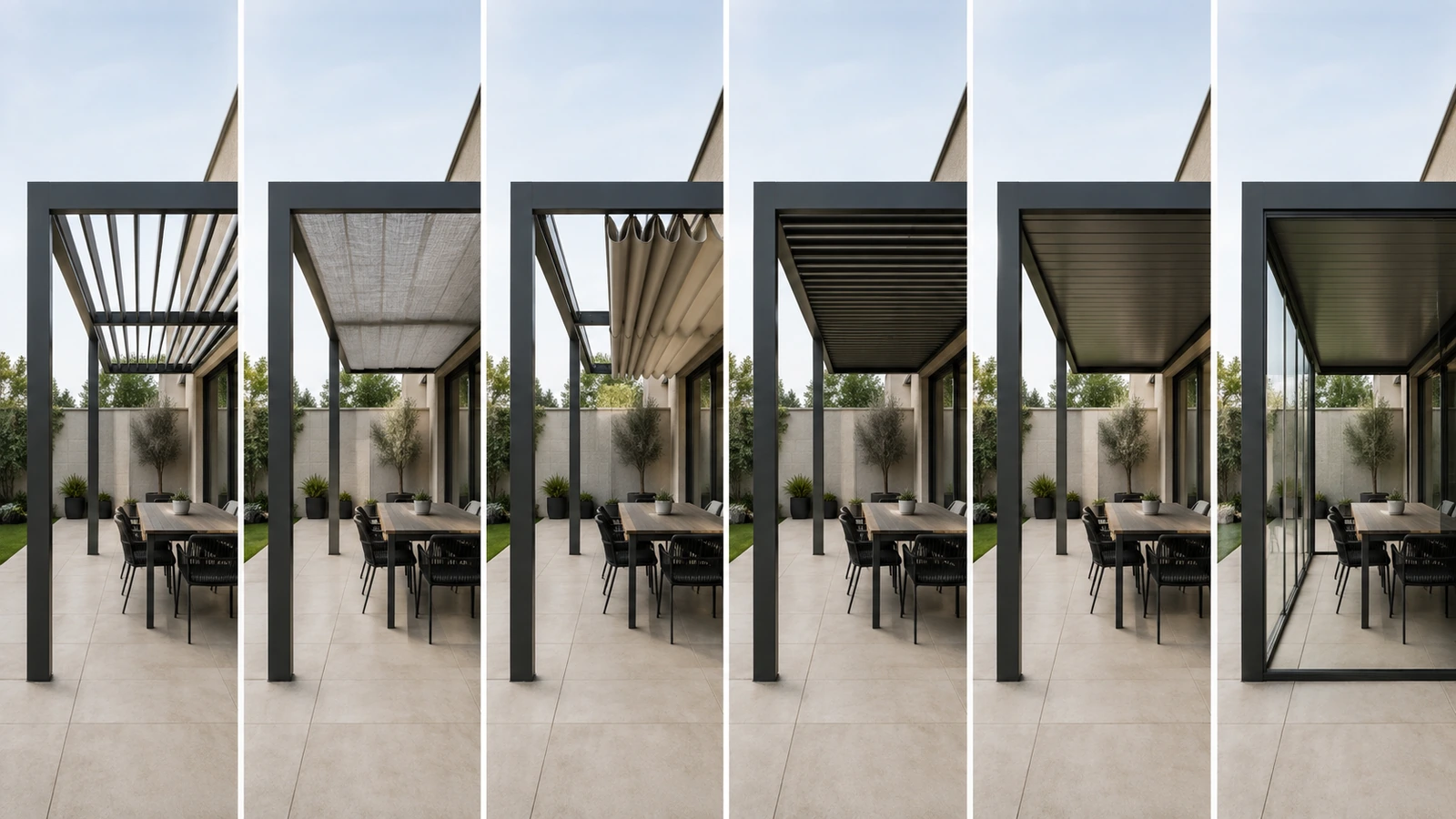
The six arrangements below show how the meaning changes as overhead coverage and side protection are added.
Open rafters
Parallel rafters break up direct sunlight but leave open gaps above. Rain and most snow pass between the members, although the frame and its connections still require structural design for local wind and snow conditions.
This is the useful baseline for the comparison. It defines an outdoor space without turning the frame into a drained roof.
Shade cloth or fabric canopy
Knitted or woven textile is primarily a shading layer. Open-weave cloth allows water through; coated or tensioned membranes may be specified as water resistant or waterproof. The fabric construction, seams, pitch, tension and drainage details determine which description is accurate.
Retractable fabric
A retractable canopy moves on tracks or guides so the user can expose or cover the space. Its rain performance comes from the selected fabric and system design, not from the fact that it retracts. The operating instructions also define when it must be opened or retracted for wind, rain or snow.
Louvered
Rotating blades overlap when closed and direct water toward gutters in the perimeter beams. Correct blade alignment, frame level, outlet capacity and installation determine how the system performs in rain. The louvered roof mechanism is explained separately.
Solid panel
Metal sheet, insulated panels and polycarbonate create a continuous fixed roof. Opaque panels block overhead sunlight; translucent panels preserve daylight. Rain performance depends on roof pitch, panel joints, flashings, gutters and outlets. The pergola roof type comparison sets out the main trade-offs.
Enclosed
Glazing, mesh screens, Zip screens or solid infill can be added around a roofed structure. Their effects differ: insect mesh closes small openings, solar screens reduce side glare, and glazing provides a more complete weather barrier.
Greater enclosure reduces natural air movement and may change how local authorities classify the structure. Ventilation, emergency access, drainage and approval requirements should therefore be checked for the specific site rather than inferred from the word pergola.
| Level | Direct sun | Vertical rain | Snow load | Air movement | Adjustable |
|---|---|---|---|---|---|
| Open rafters | Partial, according to rafter spacing and sun angle | Open to rain | No continuous roof surface | Largely unobstructed | Fixed |
| Shade cloth | According to the fabric shade rating | Open-weave cloth passes water; coated membranes vary | Follow the fabric system instructions | Depends on weave and side enclosure | Usually fixed |
| Retractable fabric | According to fabric rating when deployed | Depends on membrane, seams, pitch and tension | Follow the system instructions | Roof can retract fully | Deployed or retracted |
| Louvered | Varies with blade angle | Closed blades route water to integrated drainage | Limited to the rated configuration | Open between blades; perimeter remains open | Variable blade angle |
| Solid panel | Opaque or translucent, according to panel | Relies on joints, pitch, flashing and drainage | Limited to the engineered configuration | Perimeter only | Fixed |
| Enclosed | Depends on roof, glazing and screens | Depends on roof and wall junctions | Limited to the engineered configuration | Must be deliberately provided | Depends on roof and walls |
Sun
What gets blocked
Every roof treatment changes direct sunlight, but the result is controlled by different specifications. Rafter spacing and orientation matter on an open frame. Fabric uses a shade or solar rating. Louvers vary the opening through the day, while fixed panels provide one unchanging condition.
A fabric shade percentage should not be read as an identical percentage of visible light transmission. The test method, colour and weave affect glare, heat and daylight, so those values need to be compared on the same basis.
The current alux louver range lists blade movement up to 180 degrees, depending on the series. Opening the blades admits more sky and ventilation; closing them creates an overlapping roof surface. The louvered and fixed roof comparison explains when that adjustment is useful.
Opaque fixed panels stop direct overhead sun. Translucent polycarbonate admits daylight and solar energy, so panel colour, light transmission and solar-control specification matter.
What does not get blocked
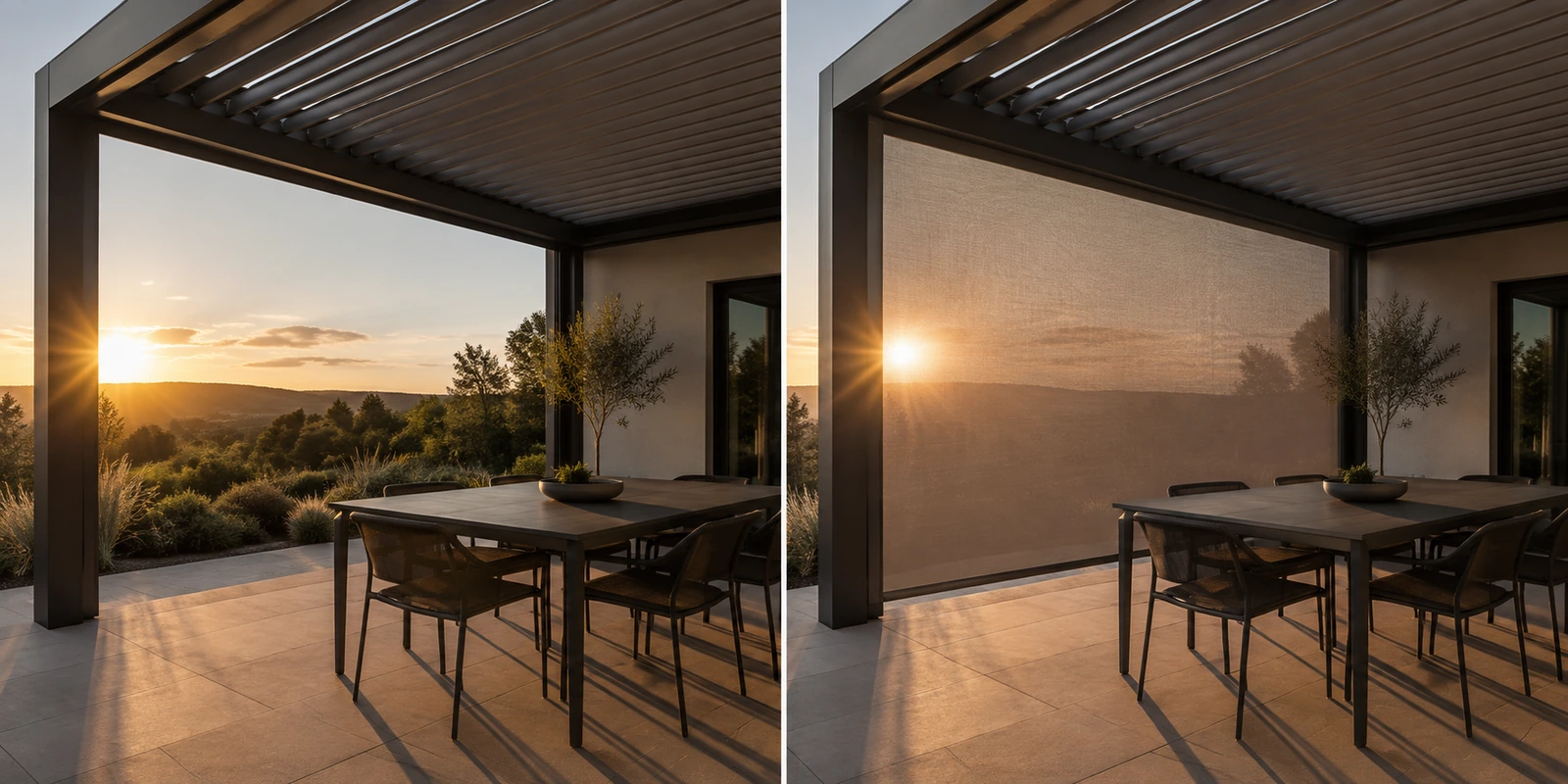
Low sun enters below the roof line, with the strongest effect often appearing on west-facing terraces late in the day. Increasing overhead coverage does little to change that geometry.
A vertical screen between the posts can intercept the lower angle. Available alux options include adjustable louver walls, fixed infill and guided Zip screens; the right choice depends on whether the priority is glare, privacy, ventilation or rain exposure.
Glare from below
Pale paving reflects. A covered structure over light-coloured stone stays brighter underneath than the same structure over dark paving or planting, which catches out anyone who assumed the roof was the whole answer.
This matters most for screens. Reflected glare arrives from below and sideways, where an overhead roof has no reach at all.
Rain
This is where covered gets used loosely, and where the difference between products is largest.
Vertical rain
Rain performance cannot be assigned by material name alone. Open-weave shade cloth passes water. A weather-rated membrane may manage rain when its seams, pitch and tension meet the system specification. Closed louvers form an overlapping, drained surface, while rigid panels rely on sealed joints, flashings and adequate fall. For a closer look at the distinction between drainage and sealing, see whether louvered pergolas are waterproof.
Wind-driven rain
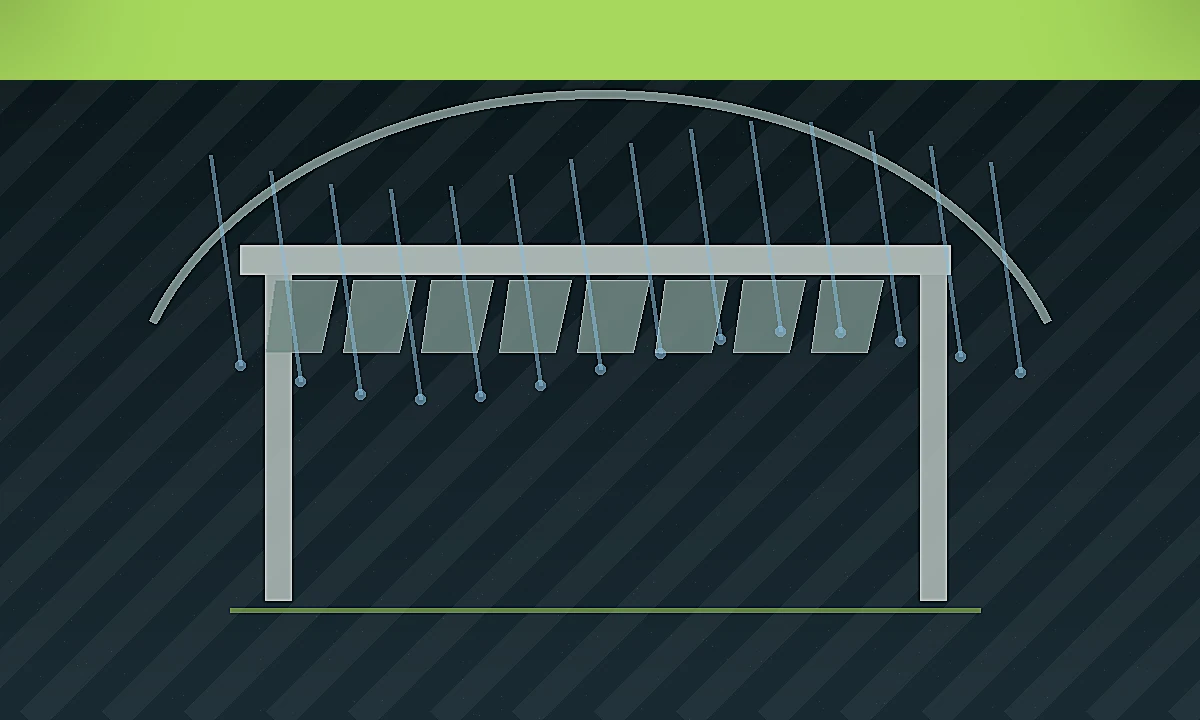
Wind-driven rain can enter through an open perimeter even when the roof above is draining correctly. Water may also be forced toward blade overlaps, eaves, wall junctions and screen edges. Side screens reduce exposure from a selected direction, but they do not turn an outdoor structure into a sealed room.
How much water arrives
The roof gathers rainfall across its full plan area. Ten millimetres of rain over a 3 by 4 metre module equals 120 litres before splash and other losses. Outlet number, section and discharge route must therefore be sized for the project rainfall intensity and roof area.
Where the water goes afterwards
Rainfall that once landed across an area now leaves through a handful of outlets. On a louvered system that means a gutter in the perimeter beam feeding a hollow post. On a solid roof it means an edge gutter and a downpipe.
Either way, the water reaches ground level in a concentrated flow. Paving falls or a drainage connection must agree with the outlet position before concrete is poured.
The honest limits
A closed louvered roof is a drainage system, not a sealed ceiling. Blade alignment, frame level, clear gutters and unobstructed outlets all affect the result. Product design and installation quality work together; neither can compensate for a drainage path that is undersized, blocked or sent to the wrong place.
Wind
A roof gives wind a surface to push against. An open frame does not.
Uplift
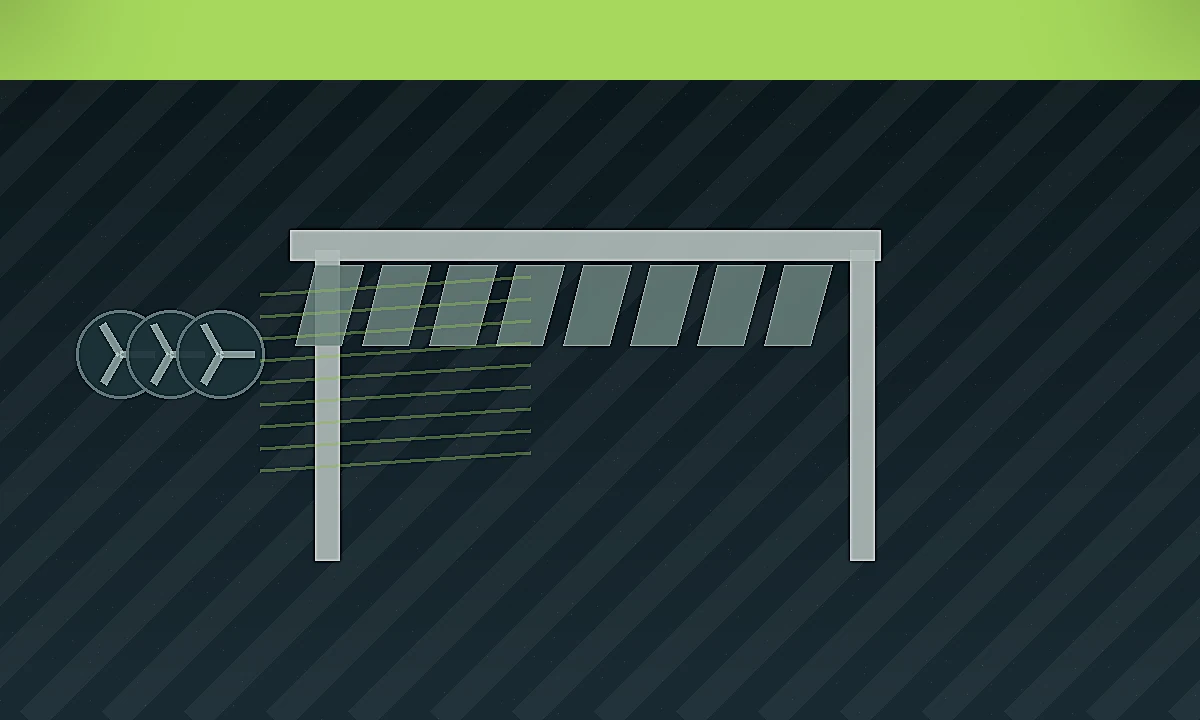
The load case that governs here acts upward, not downward. Wind passing over a roof plane lifts it, and the fixings at the base carry that load. This is why anchor specification and footing depth get more attention on covered structures than on open ones.
Side screens make it worse
Screens enlarge the area wind can work on. A structure rated with an open perimeter is not automatically rated with screens deployed, and the sensible question to a supplier is which configuration the published figure refers to.
A published wind class applies to the tested product size, anchorage and configuration. It should not be transferred automatically to a larger module or to a pergola with screens deployed. The guide to pergola wind and snow ratings explains which details need to accompany a headline figure.
What to do about it
Some motorised systems can respond to a compatible wind or rain sensor, but the action is product-specific. A sensor may retract a screen, reposition the roof or send an alert. It does not replace correct structural design or anchorage.
Confirm the trigger threshold, controlled components, safe position, reset procedure and behaviour during a power failure. Those instructions need to be settled during commissioning, before the system encounters severe weather.
Snow
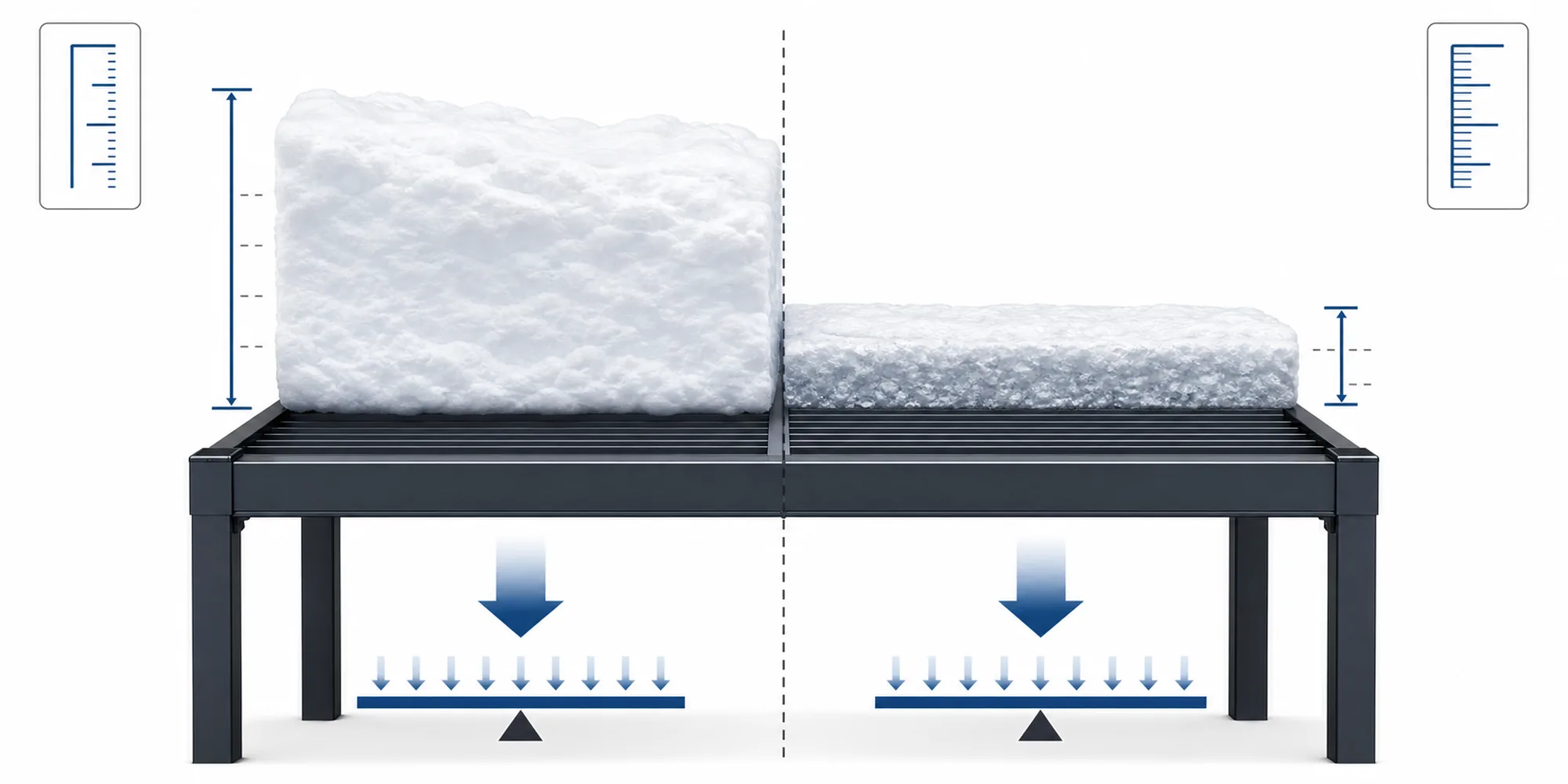
Open rafters allow much of the snow to pass between them. A continuous fabric, louvered or solid roof can accumulate snow, so its rated configuration and operating instructions matter.
Current alux product data lists 60 kg per square metre for the 100B series and 0.5 kN per square metre for the 100A series under stated configurations. These product figures are not substitutes for the site design load, which depends on local code, module size, exposure and drifting conditions.
Many retractable canopies must be opened or removed before snow. Louvered systems have a prescribed snow position and operating limit, while fixed roofs remain loaded. Follow the instructions for the exact model rather than applying one rule to every roof type.
Do not operate a motorised roof against accumulated snow unless the manufacturer expressly permits it. Snow or ice between moving components can obstruct the mechanism and overload the drive.
Heat
Roofing a space does not cool it. Everything depends on whether air still moves beneath.
Where solid roofs go wrong
A continuous roof reduces overhead solar exposure but also reduces upward air exchange. The result depends on roof colour, insulation, panel light and solar transmission, ceiling height, open perimeter area and local wind. Polycarbonate can preserve daylight, but clear and tinted sheets do not produce the same heat gain.
Why adjustable helps
A louvered roof can be positioned to intercept direct sun while leaving openings between the blades for upward air movement. The useful angle changes with orientation, season and time of day, so adjustment provides control that a fixed roof cannot.
What Covered Does Not Protect Against
Insects
Covered and enclosed mean different things. Overhead shelter does nothing about mosquitoes; screening on every side is the answer, with the enclosure consequences that follow.
Noise
Rain noise depends on panel build-up, thickness, unsupported span, fixings, insulation and the space beneath. Thin single-skin sheets usually transmit more impact sound than insulated assemblies, but material name alone is not enough to rank complete systems.
For a bedroom-adjacent terrace, ask for test data or listen to a comparable installation during rain. Connection details and loose components can be as noticeable as the roof panel itself.
Debris
Leaves settle on anything with a roof and finish in the channel. Under a tree this becomes a maintenance schedule instead of an occasional task, and gutter guards are worth pricing at the outset.
Low winter light
An opaque fixed panel that keeps winter rain off also reduces the daylight reaching the adjacent room and terrace. Adjustable louvers can reopen the roof; translucent fixed panels preserve more daylight but have different solar and ageing characteristics.
Attached or Freestanding
Both sell under the same description, and the difference changes what has to be verified.
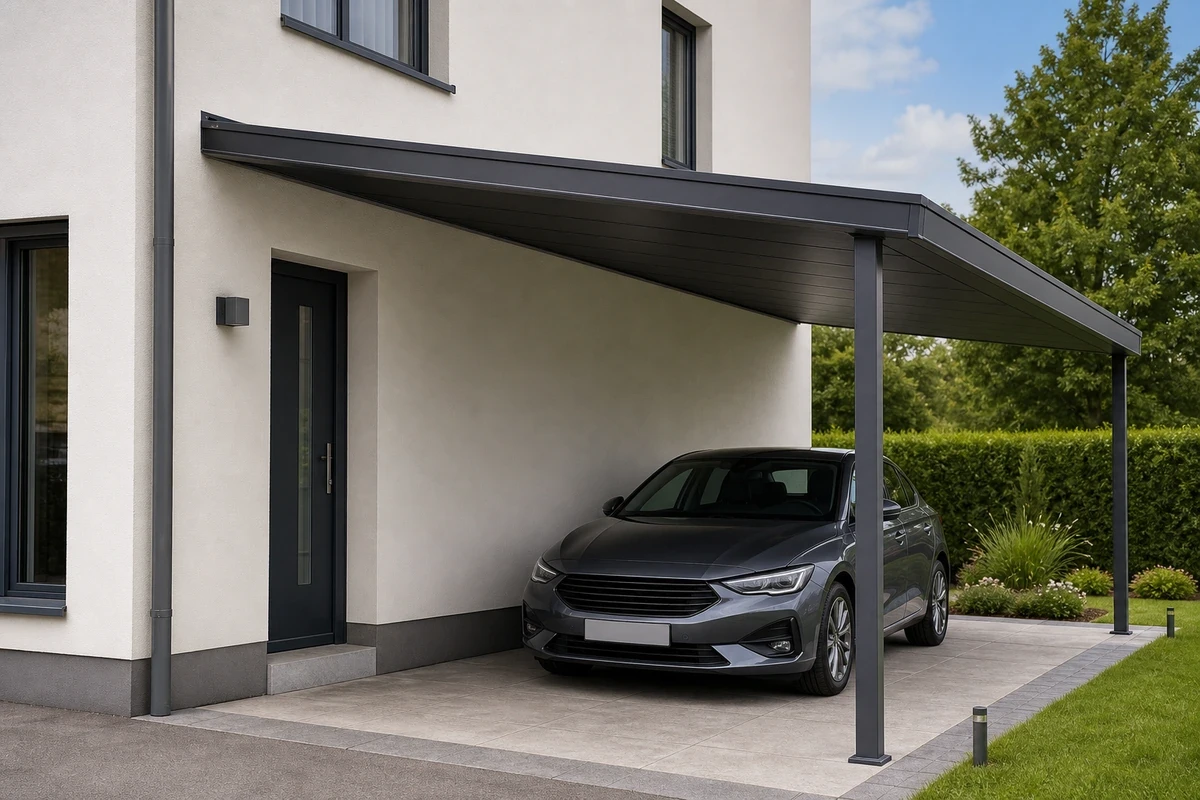
An attached structure fixes to the house through a ledger or bracket line. The wall has to carry it, which depends on whether it is solid masonry, brick veneer over frame, or an insulated render system, and the flashing at that junction has to keep water out of the wall for the life of the installation.
A freestanding one needs a fourth beam and four footings, which costs more in material. It also goes where the shade is actually wanted, and on many plots that is not against the house.
Roof-mounted versions exist for flat roofs and terraces, where the load path runs into the building structure, not into the ground. That is a structural engineering question first and a product question second.
Upkeep and Lifespan by Level
Protection has a running cost, and it differs sharply between the six levels.
Textile
Shade cloth and canopy fabric are replaceable components. Ultraviolet exposure, repeated movement, dirt, moisture and local climate affect the coating, weave and seams. Use the fabric maker’s warranty and care instructions for service-life planning instead of assuming the frame and canopy will age at the same rate.
Tension, guide alignment and drainage shape should be inspected at the interval stated for the system. Ponding or abrasion is a fault condition that should be corrected rather than accepted as normal ageing.
Polycarbonate
Polycarbonate performance depends heavily on the sheet grade, UV-protective layer, orientation and cleaning method. Yellowing, haze or brittleness can indicate ageing or incorrect exposure, but no single replacement interval applies to every sheet.
Multiwall panels also depend on edge tapes, closures and drainage details. Damaged seals can allow dust, insects or condensation into the flutes, so the edges should remain accessible for inspection.
Louvered
Moving roofs add pivots, linkages and, on powered versions, an actuator and controls. Their inspection schedule should include fasteners, movement, blade alignment, gaskets, gutters and outlets, especially where trees overhang.
Annual attention amounts to washing the profiles, clearing the channel, and cycling the roof through its full travel to confirm the linkage still moves freely. Powder coating rewards a rinse in coastal air, since salt deposits accelerate whatever corrosion the coating is holding back.
Rigid panels
Metal-sheet life depends on coating exposure, cut-edge protection, fasteners, washers and junction details. When local leaks appear, inspect penetrations, laps, flashings and sealants before assuming the panel itself has failed.
What owners underestimate
Bird activity, algae on shaded surfaces, and pollen deposits in spring all arrive whatever the covering. None threatens the structure; all affect how willing anybody is to sit underneath it. A hose reaching the roof edge is worth arranging at installation.
Key Points
- The word covered can describe six very different levels of overhead and side protection.
- Fabric rain performance depends on membrane, seams, pitch and tension. Louvers and solid panels depend on defined drainage details.
- An overhead roof does not stop low side sun or wind-driven rain entering through an open perimeter.
- Wind and snow figures apply only to the stated product size, anchorage and configuration.
- Thermal comfort depends on solar control and air movement, not simply on adding more roof area.
- The roof drainage route and ground-level discharge should be agreed before foundations or paving are completed.
Conclusion
Most disappointment here traces back to a gap between what a buyer assumed the word meant and what the product does. Decide which conditions the space has to stay usable in, check the specification against each one separately, and treat side protection as a separate question from the roof. If the covering itself is still undecided, start with the roof type comparison.
Explore the alux pergola with roof range or see how the same decisions apply to a deck pergola installation.
Frequently Asked Questions
What Does a Covered Pergola Actually Protect Against?
The answer depends on the roof and the open sides. Rafters and shade cloth mainly reduce direct sun. Weather-rated fabric, closed louvers and fixed panels can add rain protection under their specified conditions. Side screens are needed where low sun, privacy or wind-driven rain enters below the roof line.
Is a Covered Pergola Waterproof?
Covered does not automatically mean waterproof. Fabric needs a stated weather rating, suitable pitch and sound seams. Louvered and fixed roofs manage rain through overlaps, joints, gutters and outlets. Open sides and wind-driven rain remain separate exposure points.
Does a Covered Pergola Make the Space Cooler?
A roof reduces direct solar exposure, but comfort also depends on panel colour, solar transmission, ceiling height and airflow. Adjustable louvers can preserve openings for warm air to escape. A translucent fixed panel may retain more daylight and solar gain than an opaque insulated panel.
Why Is My Covered Terrace Still Sunny in the Evening?
Late-day sun can pass below the roof edge, especially on a west-facing side. Changing the roof covering will not solve that angle. A vertical solar screen, adjustable louver wall or suitable planting can reduce the exposure.
How Much Snow Can a Covered Pergola Carry?
Use the figure for the exact series, module size and configuration, then compare it with the local design snow load. Current alux data lists 60 kg per square metre for the 100B series and 0.5 kN per square metre for the 100A series under stated conditions. Site-specific engineering still governs the installation.
Does Adding Side Screens Affect the Wind Rating?
Yes. A deployed screen adds wind area and changes the loads on posts, anchors and foundations. Confirm whether the pergola rating includes the selected screens, the maximum permitted screen size, and the required retraction or sensor setting.
Where Does the Rainwater Go?
A louvered roof normally moves water through perimeter gutters and selected posts; a fixed roof usually uses edge gutters and downpipes. Ten millimetres of rain over a 3 by 4 metre roof equals 120 litres, so outlet positions and the ground-level discharge route need to be planned before paving and foundations are finished.
Does Covered Mean Insect Free?
No. An overhead roof does not close the perimeter. Insect control needs compatible mesh at the sides and careful detailing at the roof line, posts and threshold. More complete enclosure may also change ventilation and local approval requirements.