

A louvered pergola is an outdoor structure with rotating roof slats that open and close, while a fixed roof pergola carries a sealed panel that never moves. The choice looks like a product detail, but it sets your price tiers, your after-sales workload and the customers you can win. Get it wrong and you end up competing on price in a segment you were never built to hold. This guide walks through both options the way an experienced sourcing manager would weigh them.
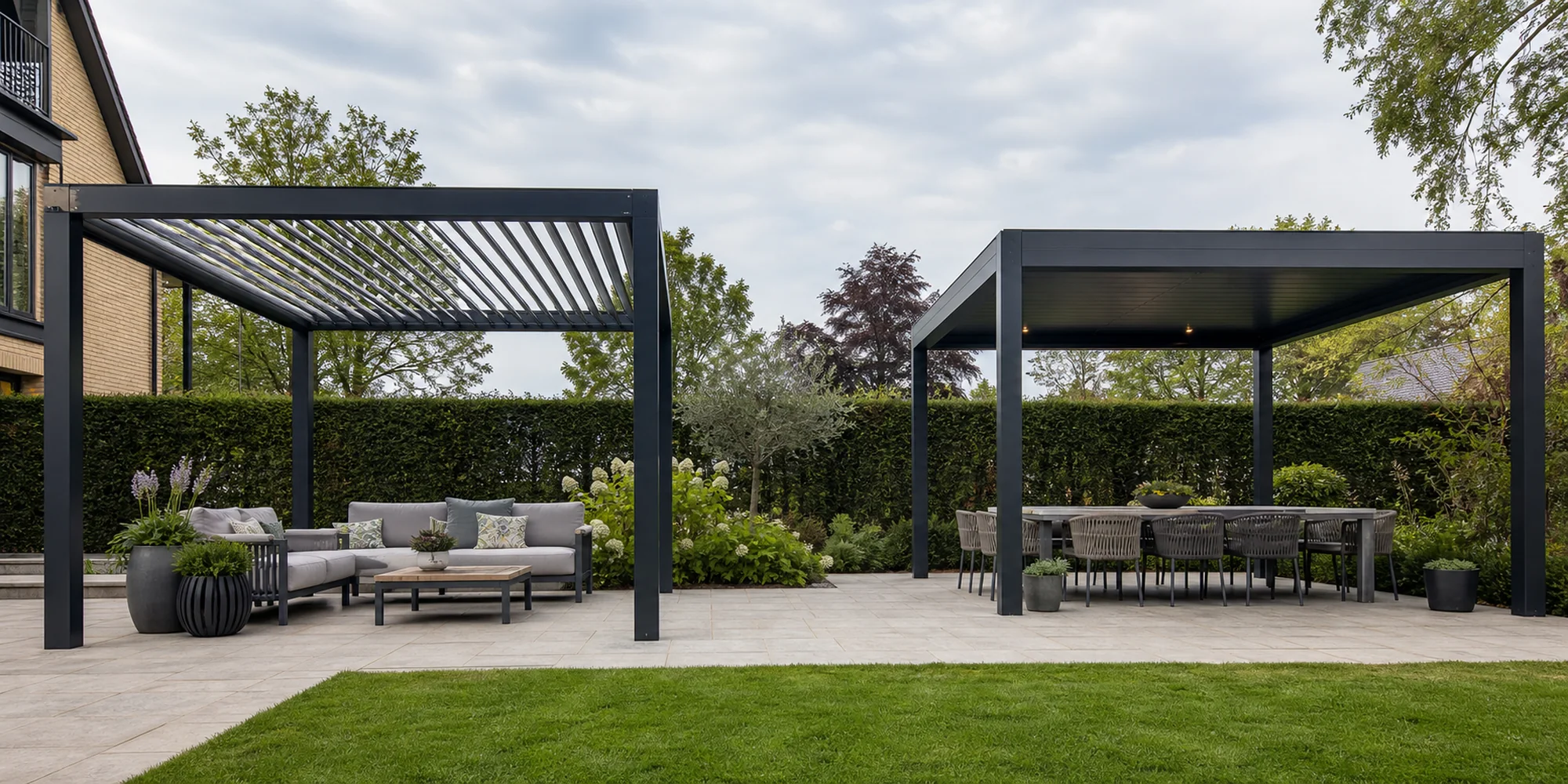
What Each Roof Type Actually Is
Both structures use the same posts and beams. The roof is the only real difference, and it drives everything downstream. Get clear on the two mechanisms first, because the rest of your decision hangs on them.
The Louvered Pergola
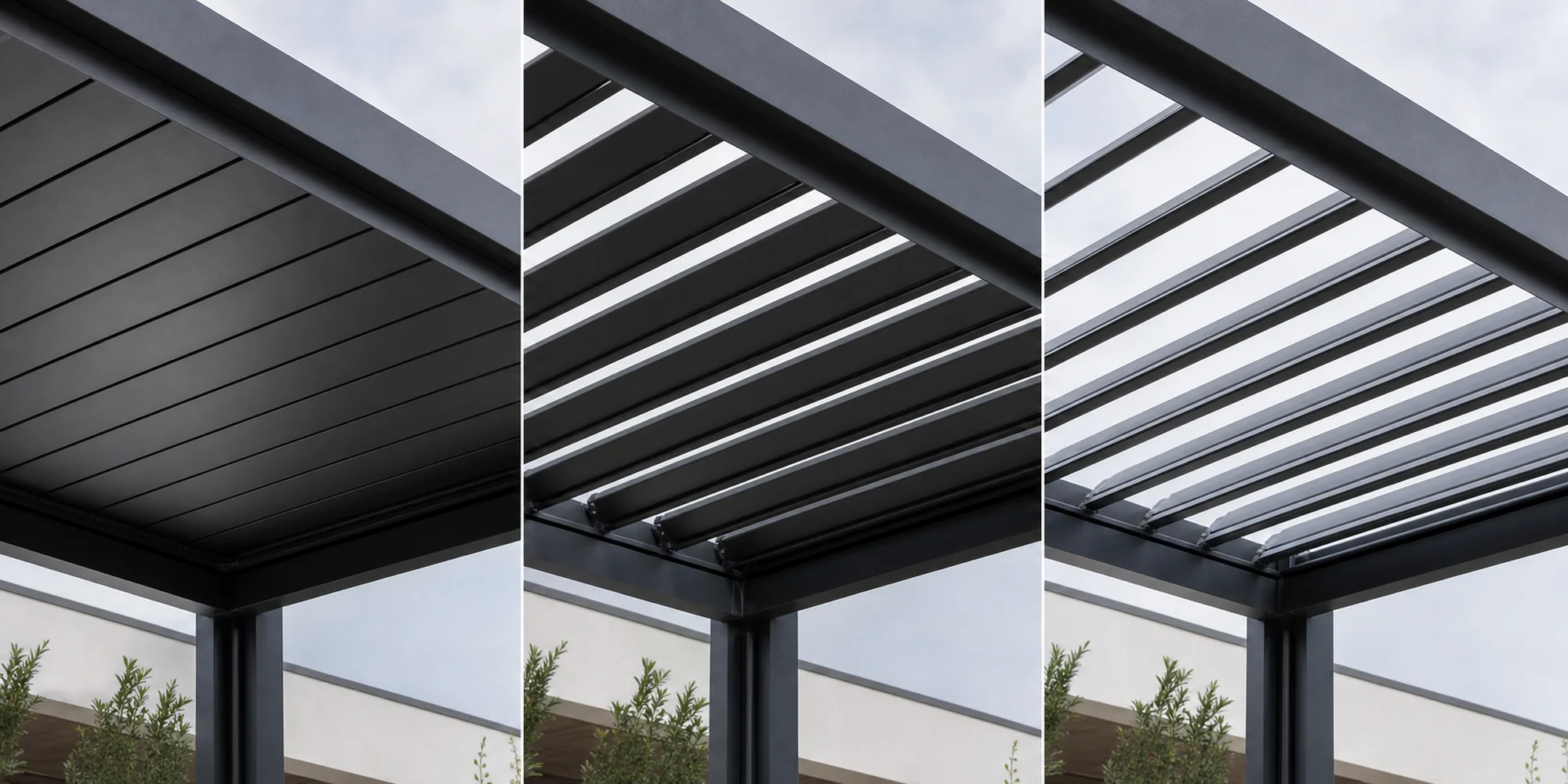
A louvered pergola uses a row of rotating blades as its roof. The blades turn anywhere from 0 to 180 degrees, driven by a hand crank or a motor. Closed, they overlap and shed rain. Open, they let sun and air pour through.
The thing to understand is that your customer operates this roof daily. That makes it a feature they interact with, not a shelter they forget. From a sales angle, that daily contact is exactly what lets you upsell later.
Louvered systems come in two tiers, and you should stock with both in mind:
- Manual: a hand crank turns the blades. Cheaper, and fewer things break.
- Motorized: a motor and remote do the work. A higher tier, and your real margin lives here.
The Fixed Roof Pergola
A fixed roof pergola swaps the blades for a solid panel that never opens. Protection stays constant, and so does the shade beneath it. Simpler product, simpler sale, but a lower ceiling.
Panel material is where fixed roofs quietly split into very different products:
- Polycarbonate: the cheapest route, though it bakes like a greenhouse in summer.
- Laminated glass: clear and premium, but heavy and easy to break.
- Insulated sandwich panel: feels like a real ceiling and handles heat best.
ALUX builds across both families, from ST-100 and AL-series louvered ranges to pergola with roof configurations. In practice, that is why this guide treats them as two tools for different jobs rather than competitors fighting over one customer.
Weather Protection Compared
Weather is the first thing your customer asks about, and the honest answer is that neither roof wins across the board. Each one takes different battles. The table sums it up, and the detail below explains where the real trade-offs sit.
The comparison below shows how each system handles the main weather loads:
| Weather | Louvered Pergola | Fixed Roof Pergola |
|---|---|---|
| Light rain | Protected when closed | Always protected |
| Heavy rain | Good, gutter dependent | Strongest option |
| Summer heat | Vents and tilts for shade | Traps heat under panel |
| Snow load | Opens to shed snow | Carries full load |
| Storm wind | Opens to cut load | Full surface exposed |
| Winter sun | Opens fully | Permanently blocked |
Rain and Sun
For rain, the fixed roof is the more forgiving product. It seals against heavy, sustained downpours with zero action from anyone. If your buyers are homeowners who are rarely home, that matters more than any spec.
Sun tells the opposite story. Louvers tilt to chase shade through the day, then open wide for winter light. A fixed roof gives you the same shadow at 9 AM and 6 PM, and under polycarbonate the trapped heat can clear a terrace by early afternoon. That summer heat complaint is one fixed roof dealers hear every July.
Snow and Wind
Snow is where the louvered design earns its keep. Open the blades and snow falls straight through, so accumulation only matters when the roof is shut. When we size an ALUX louvered model, we work from the closed-roof case first, because that is the state a dead motor leaves behind, and the range runs from 50 kg/m² up to 120 kg/m² for alpine markets.
Wind follows the same logic in reverse. Louvers open to let gusts pass, while a fixed panel meets the full storm head-on. When we run fan-rig tests on assembled ALUX units, we push airflow to Beaufort 10 conditions and watch the louvers and fasteners while the load is live, because that is where weak linkages show themselves.
Noise and Hail
One factor almost never reaches a spec sheet, and it should: noise. Heavy rain on a thin polycarbonate panel is loud enough to end a dinner conversation, while rain on closed aluminum blades stays civil. Buyers rarely ask about this until a customer complains.
Hail is the same test turned brutal. Here is how the three surfaces hold up:
- Aluminum blades: may dent in extreme hail, but rarely fail outright.
- Polycarbonate: takes the impact well, then carries the scratches.
- Glass: severe hail turns straight into an insurance claim.
If you sell into hail country, that short list is your customer’s real decision, whatever the brochure says.
Drainage: Where the Water Actually Goes
Rain protection is only half the engineering. The other half is what happens to the water once it lands, and this is where cheap products quietly cut corners. Ask about it before you order, not after the first storm.
Internal vs External Drainage
A louvered roof drains internally. Each blade feeds water into a gutter built into the beam, and the downpipes run hidden inside the posts. You get a clean frame with no visible plumbing, which sells well in premium and hospitality projects. On ALUX louvered systems, that gutter and downpipe path is sized at the design stage against real rainfall intensity, not bolted on afterward.
A fixed roof drains externally, more like a small building. The panel slopes to one edge where a surface gutter catches the runoff, and unless the installer boxes it in, that plumbing stays visible. It also clogs, since leaves gather exactly where the water runs.
The Two Questions That Expose a Weak Supplier
Blocked gutters are the number one maintenance call on fixed roofs, so drainage is worth two direct questions before you commit:
- What rainfall intensity is the gutter system sized for?
- How many downpipes does this roof area actually need?
If you get a pause instead of a number, the drainage was copied from another drawing, not calculated for yours. Undersized drainage shows up as water sheeting off the front edge in the first heavy storm, and your customer will only ever call that one thing: a leak.
Cost and Price Tiers
Neither roof is simply cheaper. What changes is where the cost sits, and more importantly, what you can keep selling afterward. This is the part that decides your margin, so it is worth slowing down on.
Where the Budget Goes
A louvered system puts its money into the mechanism—the blades, pivots, linkages and an optional motor. A fixed roof puts its money into the panel and the heavier frame that carries it. On paper the entry fixed roof often looks cheaper, simply because there is no motor to build.
But paper is where that advantage ends. Once the panel is bolted on, a fixed roof gives you almost nowhere left to go.
The Upsell Ladder
The louvered platform is really an upsell ladder wearing a roof. One base structure can be sold at three heights:
- Entry: a manual roof and basic shade.
- Mid: add a motor, LED louvers and a screen.
- Full outdoor room: glass sides, zip screens and shutter walls.
What makes this work is timing. The pergola sells at purchase, the motor sells during the quote, and the screens often sell a full season later once the customer wants more. ALUX designs its louvered accessories around one shared rotating-roof platform, so a dealer stocks a single base and quotes all three tiers from it. It is why motorized pergola ranges anchor most serious dealer programs, while a fixed roof folds those three sales into one and stops.
Shipping and Container Economics
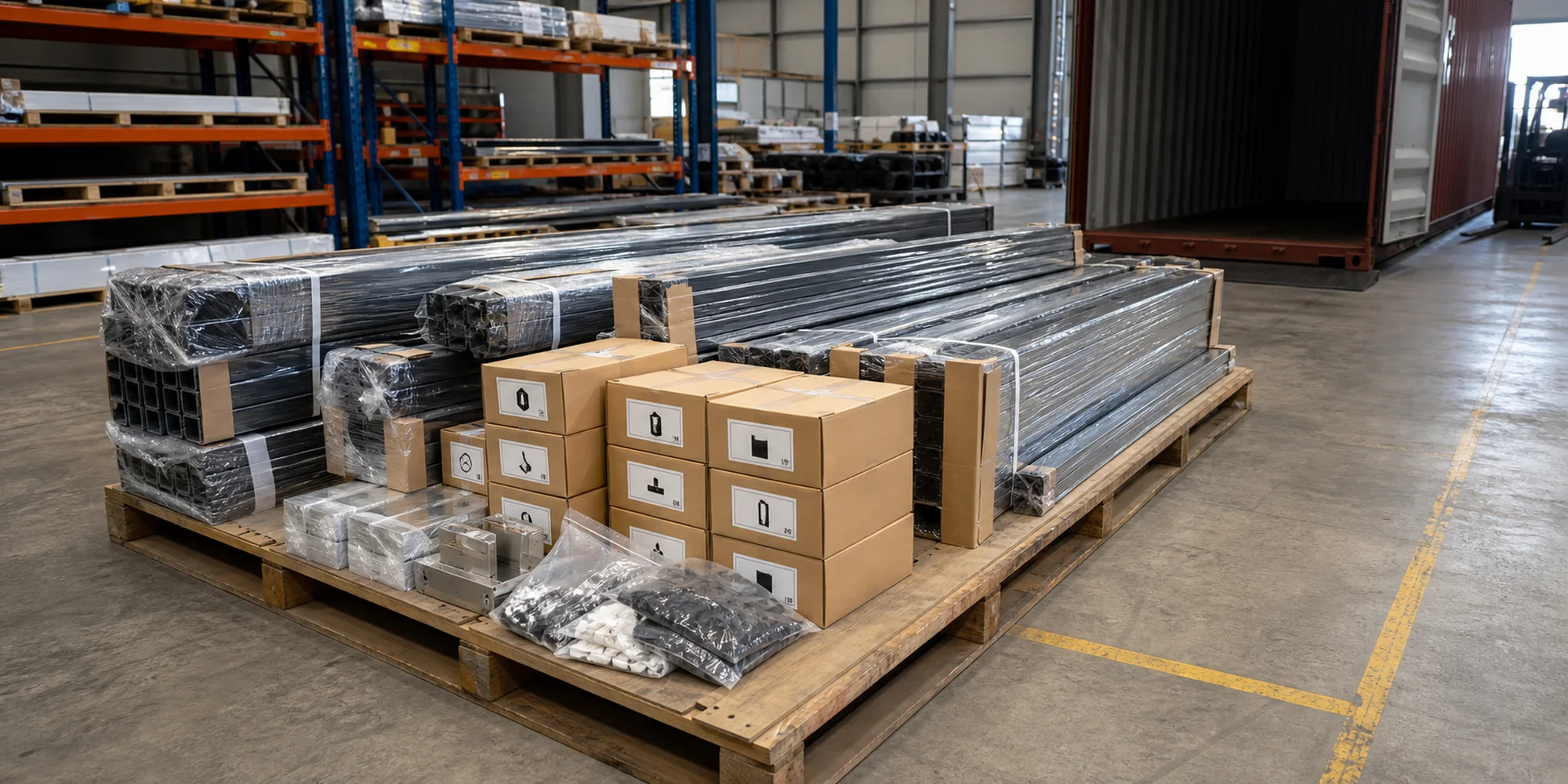
Both roofs ship as knock-down kits, but they behave nothing alike once they hit a container. This is the cost line most new importers miss, because it never shows on the factory quote.
Packing and Assembly
Louvered kits pack flat. Posts, beams, blade bundles and hardware bags stack tight, and a two-person crew puts a unit together in roughly 2 hours. The work is repetitive rather than skilled, which keeps installation cheap.
When we pack an ALUX KD kit, we label the hardware by assembly step and wrap the blades in protective film. Blade edge damage is the most common transit claim in this category, and stopping it at the packing bench costs far less than shipping replacements.
The Fixed Roof Freight Problem
Fixed roof panels are the awkward freight, and the problems compound:
- Glass: heavy, and one knock becomes a breakage claim.
- Large panels: eat container space and drag down loading efficiency.
- Low packing density: every empty inch raises your landed cost per set.
So the roof that won on the factory quote can quietly lose on the landed cost. On site it is slower too, since panels need more hands than blades and a leveling step the flat louvered frame simply skips.
Maintenance and After-Sales Load
Moving parts fail more often than static ones. There is no honest way around that, and your after-sales team is the one who pays for the choice. The trick is knowing which failures you are signing up for.
The Louvered Wear List
A louvered roof adds pivots, linkages and a motor to the list of things that can go wrong. Good manufacturing narrows the gap, though. When we cycle ALUX motorized roofs through repeated open-close runs before packing, we are hunting for the linkage faults that would otherwise surface at your customer’s site in year one.
Corrosion is the shared enemy for both roofs. ALUX validates its coated frames through 168-hour salt spray testing, with steel carrying a ZAM layer under an 80-micron powder coat. That is the number to compare when a cheaper frame tempts you.
The Fixed Roof Aging List
A fixed roof barely operates, but the panel ages in ways buyers forget to plan for:
- Polycarbonate: yellows and clouds under years of UV.
- Glass: stays clear, but every hailstorm is a live risk.
- Sealant joints: work loose in freeze-thaw climates and need resealing.
Spare Parts Reality
Spares are where the two products really diverge for your warehouse. Louvered programs stock motors, remotes and pivots, all small, light and cheap to ship anywhere.
Fixed roof programs stock replacement panels instead, and those are bulky, fragile and often discontinued in the exact tint your customer bought three years ago. Five years down the line, the motor is by far the easier spare to keep on the shelf.
Which System Fits Which Market
The smartest move here is to match the roof to the buyer, not to the spec sheet. Regional demand is consistent enough that you can plan your stock around it instead of guessing.
Reading Your Market
Different markets reward different roofs, and the pattern rarely surprises anyone who has sold across them:
- Hospitality: louvered wins, because an operable roof stretches terrace hours into revenue.
- Northern Europe: motorized louvered, pushed by changeable weather and healthy renovation budgets.
- Middle East: louvered for airflow first, since heat is the enemy, not rain.
- Tropical and budget retail: fixed roofs move in volume on price alone.
Look at the outdoor living structure market and the premium end keeps drifting toward the operable, accessorized format. If your growth plan points upmarket, that is the direction the money is already walking.
Where a Full-Range Supplier Earns Its Place
Here is the sourcing argument for buying both formats from one factory. ALUX runs both roof types out of a 46,000 m² facility in Jiangxi on shared frame platforms, backed by CE, UKCA and TÜV test documentation, ISO-certified production and a 5-year warranty. Because the formats share the same hardware logic, you can quote a fixed roof at entry level and a louvered system above it without juggling two suppliers, and put your own label on either through OEM/ODM support.
The following manufacturer-published video gives a practical overview of both roof types in use. It is useful feature context, but it is not an independent engineering test.
Watch on YouTube: a concise manufacturer overview of fixed patio covers and motorized louvered systems.
FAQ
Is a louvered pergola better than a fixed roof pergola?
Neither wins outright. Louvered systems lead on sun control, ventilation, snow shedding and upsell room. Fixed roofs lead on constant rain cover, zero operation and a lower entry price. Your best pick comes down to climate, buyer type and whether an upgrade path matters to your program. Is a fixed roof pergola fully waterproof?
A sealed fixed roof handles heavy sustained rain better than any louvered system, but only while the panel joints and perimeter sealant stay sound. Real waterproofing depends on install quality and yearly sealant upkeep, especially in freeze-thaw climates where joints loosen over time. Do louvered pergolas leak when closed?
Closed louvers overlap and channel water into a gutter and downpipe, which handles light to moderate rain well. In extreme sideways rain, a little ingress is possible by design. The system manages rain rather than sealing against it, and buyers should set that expectation with customers. Which is cheaper, a louvered or fixed roof pergola?
Entry fixed roofs usually price below entry louvered units, since there is no motor to build. Motorized louvered sits higher up. Landed cost can flip the picture though, because bulky panels waste container space that flat-packed blade kits use efficiently. Which pergola type is better for snow regions?
Louvered roofs can open to let snow fall through, and closed ratings in this category run from 50 to 120 kg/m². A fixed roof carries every snowfall continuously, so it needs a rating matched to the site’s worst season rather than its average winter. Can a fixed roof pergola become a louvered roof later?
Rarely worth it on cost. The frame, beams and drainage are all engineered around one roof type, so retrofitting means replacing most of the structure. The roof decision belongs at the point of purchase, not a season later.
Conclusion
Strip away the specs and this is a business model decision. A fixed roof hands you a simple, sealed, price-led product with a low ceiling, while a louvered roof hands you an operable platform with a motor, an accessory ladder and the whole hospitality segment attached. Map your climate, your drainage expectations and how your customers actually spend, and the right roof usually names itself. A manufacturer like ALUX that builds both formats on shared platforms lets you run both price ladders at once, so your market decides the winner instead of your supplier.