

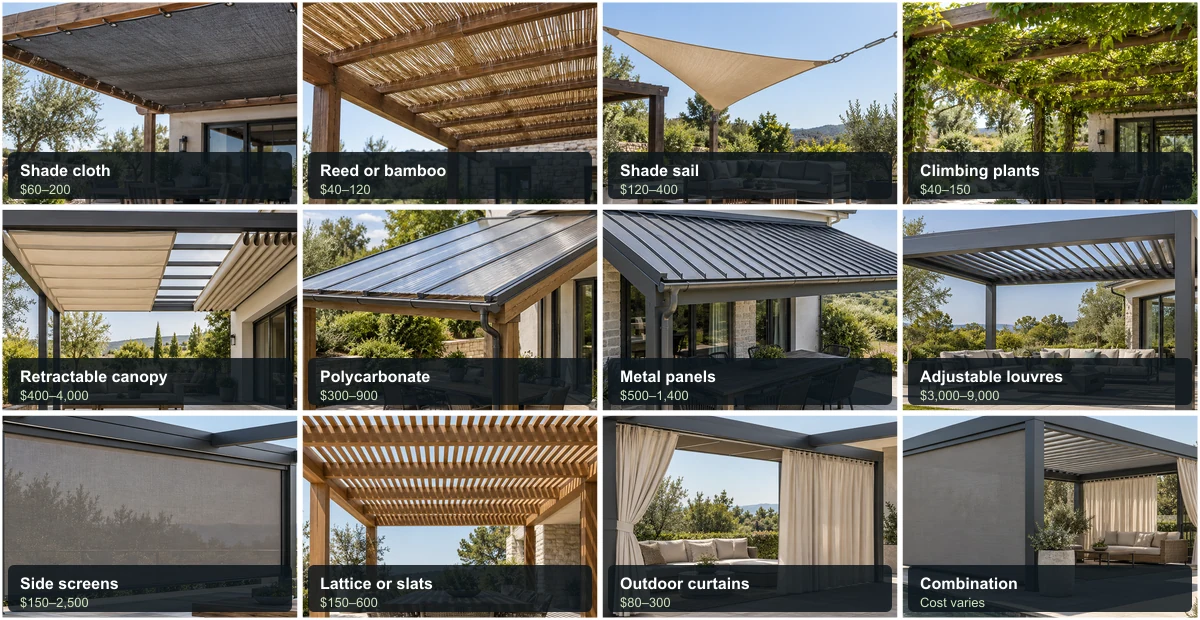
Twelve ways to cover a pergola, from a fifty dollar roll of screening to a motorised roof that answers to an app. Each entry says what it looks like, what it costs, how long it takes to put up, and the situation it suits. Costs are for a bay of roughly 12 by 12 feet, materials only unless stated. For the permanent options, pergola roof types compared goes deeper on how each behaves over years.
| Cover | Cost, 12×12 bay | Fitting | Life | Rain | Low sun |
|---|---|---|---|---|---|
| Shade cloth | $60 – 200 | An afternoon | 3 – 12 seasons | No | No |
| Reed or bamboo | $40 – 120 | 2 hours | 2 – 4 seasons | No | No |
| Shade sail | $120 – 400 | Half a day | 5 – 8 seasons | Light only | Partly |
| Climbing plants | $40 – 150 | 3 – 5 years to cover | Decades | No | Partly |
| Retractable canopy | $400 – 4,000 | A day | 8 – 12 seasons | Light only | No |
| Polycarbonate | $300 – 900 | A weekend | 10 – 20 years | Yes | No |
| Metal panels | $500 – 1,400 | A weekend | 30 years + | Yes | No |
| Adjustable louvres | $3,000 – 9,000 | 1 – 2 days | Decades | Yes, closed | No |
| Side screens | $150 – 2,500 | A few hours | 5 – 15 seasons | Sideways only | Yes |
| Lattice or slats | $150 – 600 | A day | 10 years + | No | No |
| Outdoor curtains | $80 – 300 | 2 hours | 3 – 6 seasons | No | Yes |
Note the last column. Nine of the eleven are overhead covers, and overhead covers do nothing about sun arriving sideways at six in the evening.
1. Shade cloth pergola cover
The default cheap answer, and the one people keep.
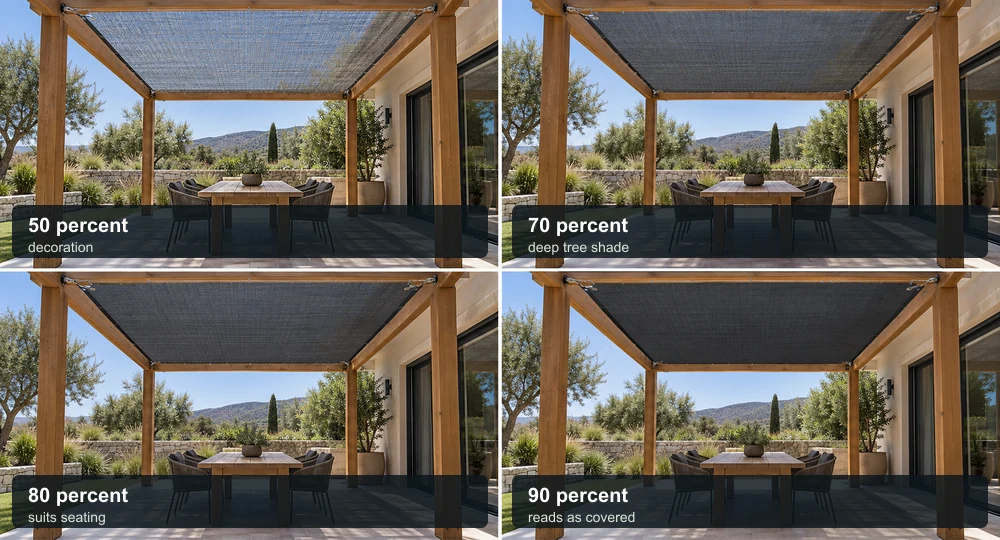
Knitted polyethylene mesh stretched across the rafters, fixed with cable ties or threaded onto a simple wire. It reads as a soft translucent ceiling and moves slightly in a breeze, and on a patio it is often all the situation needs. Buy it by shade factor: 70 percent gives you the light level of deep tree shade, 90 percent reads as properly covered and starts to feel enclosed, and anything under 50 percent is decoration. For a seating area, 80 percent is where to start.
Cost 60 to 200 dollars. Time an afternoon. Lasts 3 to 5 seasons for budget grade, closer to 12 for commercial. Standard rolls are 6, 12 or 20 feet wide, so a 12 foot bay takes one piece with no seam.
Because the mesh breathes, heat does not build underneath the way it does under a solid panel, and wind passes through instead of trying to lift it. That is the argument for cloth over solid fabric on an exposed site.
Skip it if you need rain cover. Water goes straight through, and in a shower the mesh holds droplets that fall in a second wave when the wind moves it.
2. Reed or bamboo pergola screening
The one nobody expects to look as good as it does.
Rolls of split reed or bamboo from a builders merchant, laid over the top of the rafters and tied down at intervals. The light through it is dappled and warm, and against timber it looks intentional, not makeshift. Rolls come in 4 by 16 foot lengths and overlap easily, so a 12 foot bay takes 3 rolls with the laps.
Cost 40 to 120 dollars. Time two hours. Lasts 2 to 4 seasons.
It comes off in ten minutes for winter, which matters more than the price. That is the whole appeal: seasonal cover without a permanent decision.
Skip it if the site is windy. Reed catches air, the ties give out first, and a roll that lifts at one corner peels the rest with it.
3. Shade sail over a pergola
The one that looks deliberate on a photograph and needs the most thought.
A triangular or square panel of tensioned fabric anchored to three or four points, commonly the pergola posts plus a wall bracket. Hung at an angle instead of flat, it sheds water and reads as architecture.
Cost 120 to 400 dollars including hardware. Time half a day. Lasts 5 to 8 seasons.
Angle is what makes or breaks it. Flat sails pool water and stretch. A sail with real fall drains and stays taut, and the same tilt catches some of the low sun that flat covers miss entirely. Aim for at least 15 degrees between the high and low corners.
Skip it if you have no solid anchor points. Every load in a sail goes into its corners, and a post that was fine holding a rafter may not be.
4. Climbing plants as a pergola cover
The oldest cover on this list and still one of the best when there is time.
Wisteria, grape, star jasmine or hops trained up the posts and across the top. In leaf it gives dense dappled shade that no fabric matches, plus scent and a temperature drop from evaporation. In winter it drops and lets the light back through, which solves a problem most covers create.
Cost 40 to 150 dollars for plants. Time an hour to plant, 3 to 5 years to cover. Lasts decades.
Pick by growth rate and by how much cutting back you are willing to do. Star jasmine is manageable and evergreen in mild climates. Wisteria is spectacular and needs pruning twice a year or it takes the structure over.
Skip it if the frame is light. A mature wisteria hangs a couple of hundred kilos off timbers that were sized for nothing, and the growth gets into gutters and under cladding if it is not cut back.
5. Retractable pergola canopy
The one people buy expecting rain cover and get shade cover.
Fabric panels that slide along a track, either drawn by hand with a pole or run on a motor. Open, the sky is back. Closed, you have full shade and protection from a shower.
Cost 400 to 1,500 dollars manual, 1,500 to 4,000 motorised. Time a day with two people. Lasts 8 to 12 seasons on the fabric, longer on the track.
A motorised version with a wind sensor retracts itself when a front comes through whether anyone is home or not, which is the feature that keeps fabric alive on an exposed site. Manual versions need someone to remember, and the fabric outlasts the memory.
Skip it if heavy rain is the problem. Water pools in the middle of any slack panel, the pool deepens, and eventually the panel becomes a bag.
6. Polycarbonate pergola roof panels
The one that keeps the space bright and dry at the same time.
Corrugated or multiwall sheet screwed to purlins across the top. It passes daylight while blocking UV, typically 99.9 percent of it, so the space underneath stays usable and does not go cave-dark the way it does under metal or timber.
Cost 300 to 900 dollars. Time a weekend. Lasts 10 to 20 years.
Multiwall runs cooler than clear single sheet, with suppliers reporting up to 15 degrees below the panel compared with open sun, and 16 mm triple-wall outperforming 6 mm twin-wall. Sheet thickness for a pergola span runs 6 to 25 mm. Single wall is easier to keep clean, since multiwall traps dirt and insects between its layers where nothing can reach them.
Skip it if the frame is dead level. Panels need fall, commonly 3:12 for exposed-fastener types, or water sits on the fixings.
7. Metal pergola roof panels
The one that handles weather better than anything else here and asks for the most from the frame.
Steel or aluminium sheeting in corrugated, R-panel or standing seam profile. It is the most weather-resistant option here, it does not rot or tear, and a good finish holds colour for decades.
Cost 500 to 1,400 dollars. Time a weekend. Lasts 30 years plus.
26 gauge suits a typical patio bay, covering purlin spacing to 24 inches and snow to 40 psf; move to 24 gauge above that. Rain on a bare panel is audible, and thicker gauge with a deeper rib is how you buy quiet. A steel roof pergola is a different frame specification, since a solid roof stops shedding weather between the rafters and starts handing it to the posts. How the panel choice itself plays out is set out in pergola with a metal roof.
Skip it if the patio is somewhere you sit through July afternoons. The panel blocks the sun and then radiates its own heat downward.
8. Adjustable louvred pergola roof
The one that changes its mind, which is the point.
Aluminium blades on a shared linkage, angled by hand or motor. Open, it is an open pergola. Closed, the blades overlap into a continuous surface that drains into a gutter inside the beam. alux runs a 0 to 180 degree range, and the useful positions are the ones in the middle.
Cost 3,000 to 9,000 dollars installed. Time 1 to 2 days, professionally. Lasts decades on the structure. alux tests its frames to EN 13561 Class 6 for wind, which is the sort of figure worth asking any supplier for before comparing prices.
It is the only entry here that solves the July and January problem with one purchase, since it shades when you want shade and opens when you want light back.
Skip it if the budget is the constraint. There is a mechanism where fabric has none, and it costs accordingly.
9. Side screens and roller blinds
The one that solves the problem no overhead cover touches.
Fabric or mesh panels that drop down one elevation, either free-hanging on a roller or guided in side channels. This is the answer to low sun, and it deserves its own explanation.
At breakfast and in the last two hours of the day, sunlight arrives almost horizontally. It passes under the roofline entirely, at the height of somebody sitting down, and lands on faces instead of the floor. No overhead cover of any material intercepts it. Not fabric, not polycarbonate, not louvres, not a solid roof. The answer is vertical or it is nothing.
Cost 150 to 500 dollars for a roller blind, 800 to 2,500 for a guided zip screen. Time a few hours. Lasts 5 to 15 seasons depending on grade.
Guided screens run in channels on both edges, so they hold their line in a breeze instead of billowing. alux builds them to match the frame, which means the channels are part of the structure, not bolted on afterwards. A free-hanging blind costs a fraction and moves in wind.
Skip it if you have not worked out which elevation. Sit in the chair you actually use, at the hour you actually use it, and note which way you are squinting.
10. Lattice or slatted pergola cover
The one that adds pattern more than shade.
Timber or aluminium slats fixed above the rafters at an angle, either fixed louvre style or square trellis. It throws a strong graphic shadow and gives partial cover without closing the space in. Slat spacing decides everything: at 2 inch gaps on 4 inch boards you get roughly a third cover, at 1 inch gaps closer to two thirds.
Cost 150 to 600 dollars. Time a day. Lasts 10 years plus in aluminium, less in softwood.
Angle the slats to face the midday sun and coverage rises without losing the open feel. Fixed at 45 degrees they read as solid from below and open from the side, which is why the same panel looks different from the house and from the garden.
Skip it if leaves are an issue. Slats catch everything falling from above and hold it.
11. Outdoor curtains on a pergola
The one that does the most for the least, in the right garden.
Weighted fabric panels hung from a wire or track along one or more sides, tied back when not needed. They give shade at low angles, privacy from a neighbour, and a noticeable drop in wind.
Cost 80 to 300 dollars. Time two hours. Lasts 3 to 6 seasons.
Skip it if the site is exposed. Unguided fabric in wind is loud, and it takes its own fixings out eventually.
12. Combining two pergola covers, which is what most gardens need
Few gardens have one problem. Nearly every option above answers one.
The common pairing is overhead plus one side. Shade cloth above and a roller blind on the west elevation covers the two commonest complaints for under 500 dollars. Polycarbonate above with zip screens on two sides makes the space usable in rain and at six in the evening, for several thousand. An adjustable roof with guided screens does both from one control.
Order matters. Go overhead first if the space is unusable at midday, because that is the longer stretch of the day and the cheaper fix. alux sells the roof and the screens as one system for that reason, across the pergola with roof range, though two separate purchases from two suppliers works just as well if the timing suits. Go to the side first if the complaint is glare at dinner, since no amount of overhead spending touches it.