

Whether a steel pergola rusts is decided by what sits under the powder, not by how thick the powder is. A steel frame finished with a passivated zinc-aluminium-magnesium base and roughly 80 microns of powder over it behaves differently in year six than the same frame with 80 microns sprayed straight onto blasted steel. Both quotations say powder coated. Both may quote the same micron figure.
This page sets out what the coating stack is made of, where it fails first, and what load figures mean once you ask which model and which report they attach to.
Why Steel at All
Steel earns its place in a pergola for one reason and pays for it in another.
The load argument
Steel carries more load per unit of section than aluminium. A steel post at 100 by 100 mm does work that an aluminium post needs 120 by 120 mm to do. That matters on a terrace where post footprint is visible, and on any project keeping column count down.
Fewer posts means fewer foundations, fewer deck penetrations, and a cleaner sightline from indoors. Blade sections follow the same logic. On the alux range the ST-100-A carries a 123 by 19.8 mm blade and the ST-100-B-KD a 150 by 34 mm blade, a 71.7 percent gain in depth. Both cover spans that an equivalent aluminium profile needs more depth to reach.
The price of that strength
Aluminium forms its own oxide film. Break the surface and the exposed metal passivates itself within hours.
Steel does not do this. Steel that loses its coating starts oxidising, and the oxide expands, which lifts the surrounding coating and exposes more metal. Every steel structure sold for outdoor use is therefore a coating question wearing a structural answer. That is why the specification has to name the stack, not the finish. The sections above are only half of what a buyer needs.
The Coating Stack, Layer by Layer
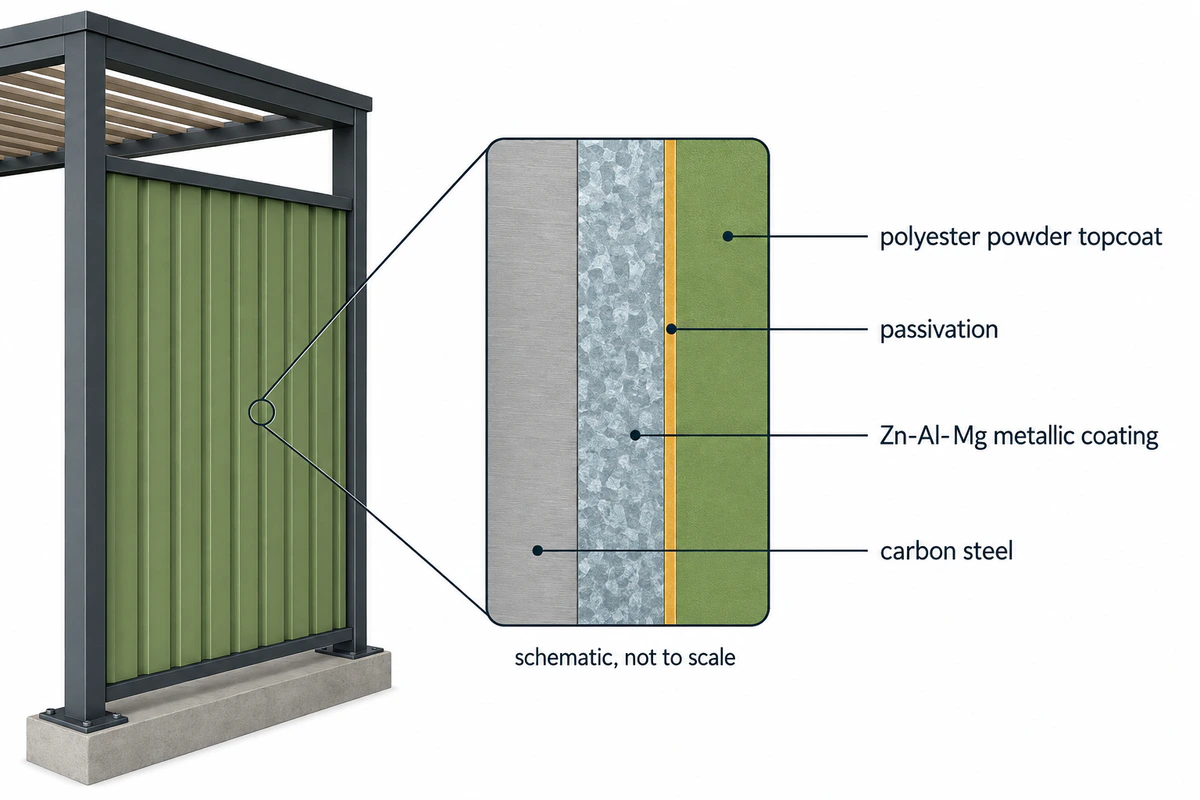
Three layers, each doing something the other two cannot.
Pretreatment and passivation
The steel has to be chemically cleaned and passivated before anything is sprayed onto it. Blasting alone strips mill scale but leaves nothing for the coating to key into. Shops that skip this step watch rust creep along sharp edges and lapped seams within months of a part going outdoors.
This stage costs the least and is the one most often omitted, because nothing about it is visible on delivery. No buyer can audit pretreatment once a frame is finished. The only practical check is documentary: ask which chemical process was used, and ask for the salt spray result that the process produced. Salt spray testing to ISO 9227 is the standard that puts a number on it.
The ZAM base
Zinc-aluminium-magnesium is a sacrificial layer. Where moisture gets in through a scratch, the alloy gives itself up in place of the steel, and what it leaves behind plugs the gap instead of creeping under the film. Engineers working on outdoor steel have said the same thing for years: put a zinc-based layer on steel first, then topcoat it. A powder film on bare steel is a barrier, and a barrier only works while it is intact.
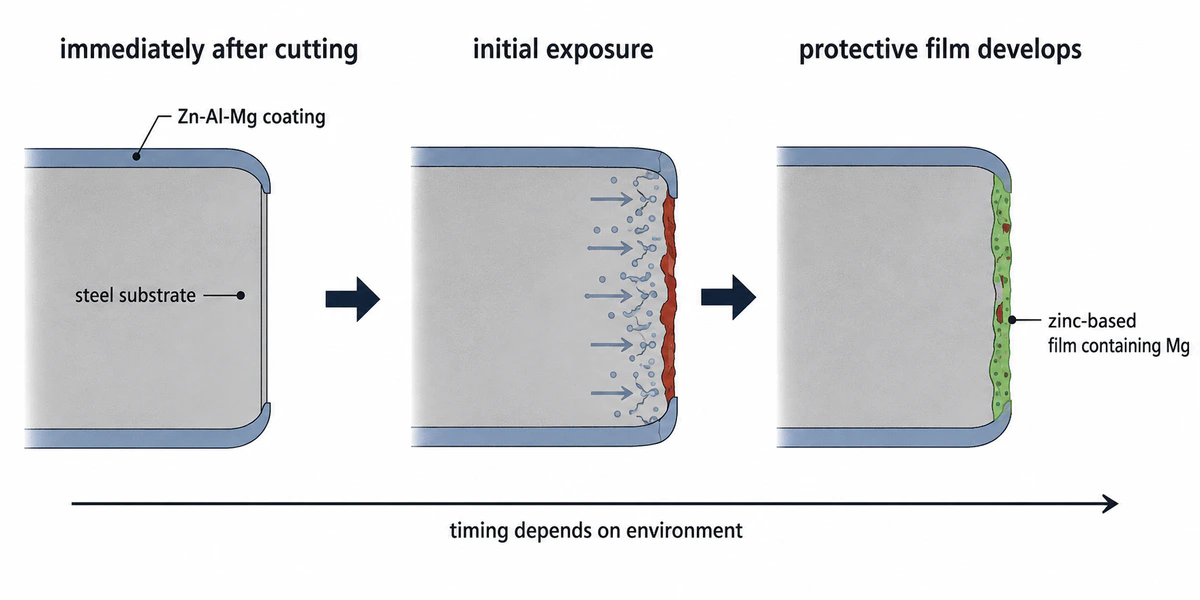
The distinction shows up at cut edges and drilled holes, where fabrication exposes bare steel long before anything in service damages it. On a passivated ZAM base those exposures are protected from the moment the part is made. On bare steel they are protected only by whatever powder happened to wrap the edge.
The powder finish
alux builds its steel range on a passivated zinc-aluminium-magnesium base with roughly 80 microns of polyester powder over it. That stack is tested to 168 hours of salt spray under ISO 9227 and 100 hours of UV, and warranted five years on the finish. This is the decorative barrier: it retains pigment and resists chalking. Every quotation names it, and alone it decides the least.
What 168 hours of salt spray actually means
Salt spray hours do not convert to years on a wall chart. ISO 9227 runs a 5 percent sodium chloride fog at 35 degrees Celsius, pH 6.5 to 7.2, which is an accelerated comparison test, not a life prediction.
Its value is relative: 168 hours without blistering is measured against stacks failing at 24 or 72 hours. Treat the hour count as a ranking. Then ask one further question: was the test panel scribed. A scribed panel is testing the base layer underneath. An unscribed panel is only testing the powder.
| Layer | What it does | How it fails when missing | How to verify |
|---|---|---|---|
| Chemical pretreatment and passivation | Creates adhesion and a corrosion-inhibiting conversion film on the steel surface | Coating loses grip at edges and seams; rust appears in months, not years | Ask which process; ask for the salt spray result it produced |
| ZAM base | Sacrificial zinc layer that corrodes in place of the steel and seals the breach | A scratch or drilled hole exposes bare steel with nothing behind the powder | Ask whether the panel tested to ISO 9227 was scribed |
| Polyester powder, approx 80 microns | Barrier film, colour retention, UV and chalking resistance | Nothing initially; the deficit shows as fade and chalking by year three | Ask for the film thickness measurement location, not just the figure |
Why Micron Count Is the Wrong Comparison
Here is the part that should change how you read a quotation.
Edges get less coating than faces
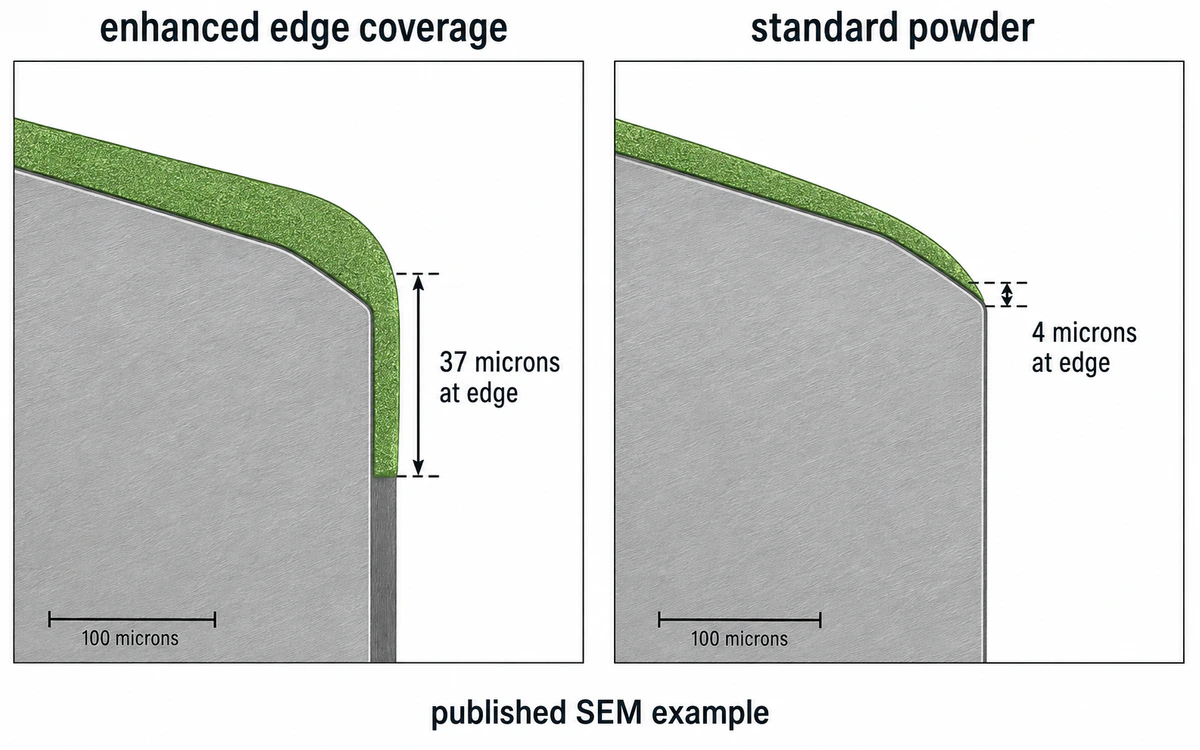
Electrostatic spray does not deposit evenly. Charge crowds onto broad flat faces and starves across sharp edges, weld seams and laps, so the film on an edge is materially thinner than the film on the face beside it. A stated figure of 80 microns is a face measurement. Nobody measures the edge, and the edge is where failure starts.
The geometry of a louvered pergola makes this worse than it is on a flat panel. A blade has two long edges, two end profiles and a pivot seat at each end. A post has four corners and a base plate weld. Count the linear metres of edge in a single bay and the number is larger than the area of flat face, which inverts the assumption behind a single micron figure.
What eighty microns on bare steel actually buys
One pass of powder over blasted steel will not survive an exposed site. Coating shops running that sequence field complaints inside twelve months, and the complaints arrive from edges and seams. Two suppliers can print eighty microns on the same line of a datasheet and ship frames that look nothing alike by year five. Comparing the micron figure alone compares a number measured at the one place the coating does not fail. Ask what is under it.
Coating specialists use a rough benchmark for this: a powder coated outdoor part that degrades in under five years points to a process problem, not to material fatigue. That timescale is useful when reading a finish warranty. A three year coating warranty and a five year coating warranty are not two points on the same scale, because the first one expires before the process problem would have shown itself.
What Happens When the Coating Is Broken
No coating survives a decade of garden furniture, ladders and branches without a mark.
How steel and aluminium differ once scratched
On aluminium the exposed metal reoxidises and the damage stays cosmetic. On steel, moisture reaches the base metal and corrosion travels under the film, which is why an abrasion on a steel frame becomes a blister and then a flake. A ZAM base changes the outcome, since the zinc layer corrodes preferentially and stops the spread at the edge of the wound, but it does not make the frame indifferent to damage.
The repair is straightforward and worth doing early. Clean the damage, then brush on an outdoor grade touch-up matched to the colour. The point is not appearance. It is closing the path that lets moisture sit against bare metal for a season.
When to specify aluminium instead
On a coastal site with persistent salt load, or on a project where the structure will be knocked regularly, the honest specification is aluminium. Steel and aluminium is worth reading before committing, because the strength advantage that makes steel attractive on span does not survive an environment that attacks the coating faster than the warranty runs. alux builds both lines and will say so during specification. A supplier who recommends steel for every site is selling what it stocks.
Load Capacity and What the Number Attaches To
A load figure without a model number and a report reference is a marketing value.
Snow
Snow load is quoted per square metre against a specific configuration. alux rates the 100B series at 60 kg per square metre and the 100A series at 0.5 kN per square metre, each verified by TÜV loading tests on stated module sizes. Those figures move with span and blade depth, which is why a single number covering an entire product line should be treated as an advertisement. Snow load and wind ratings sets out how the two are calculated and where they diverge.
Wind
alux tests to EN 13561 Class 6 under TÜV Rheinland, equivalent to Beaufort 9, under report CN25HMEF 001. That band covers gusts of 75 to 88 km per hour, or 20.8 to 24.4 metres per second.
Read what the certificate covers. It describes an operating envelope with the blades held in their rated attitude, measured on one named configuration at 24.4 m/s peak. It says nothing about an open canopy abandoned through a squall, and it is silent on the anchorage beneath, which belongs to whoever poured the slab. Request it, check the identifier matches the assembly you are buying, and treat a vendor unwilling to release it as having quoted a category, not a product.
Why the attachment matters more than the value
Local design values are not the same as tested values. Snow and wind loading at a given address is set by local code and calculated by a licensed engineer against local ground snow and basic wind speed. A tested rating tells you what the structure withstood under test conditions. It does not tell you whether it satisfies the code where the structure will stand.
Sections, Spans and Container Quantities
Numbers that a quotation should contain and usually does not.
Blade and post sections
alux steel systems run a 100 by 100 mm post carrying a 123 by 19.8 mm blade on the ST-100-A, or a 150 by 34 mm blade on the ST-100-B-KD. The aluminium AL-120-A-KD pairs a 120 by 120 mm post with a 158.8 by 34.7 mm blade, so the steel post takes 30.6 percent less floor area. Wall thickness and section depth together set the span, and a supplier who will not state both is quoting a picture.
Depth resists bending. Wall thickness resists local buckling at the pivot seats and at the point where the blade meets the rail. A deep blade with a thin wall passes a photograph and fails at the ends.
Wall thickness, welds and the heat affected zone
Welding burns off coating either side of the seam. On a factory-welded steel frame the joint is made first and the whole assembly is coated afterwards. A welded-then-coated frame outlasts a coated-then-welded one whatever the specification sheet says about microns.
Bolted knock-down construction avoids the problem differently. The KD suffix on the ST-100-B-KD and AL-120-A-KD denotes knock-down assemblies. Components are coated individually before they ever meet, so no seam is left uncovered and no heat affected zone is created on site. The trade-off is fastener count: a knock-down bay carries more mechanical joints, each of which is a potential ingress point if the washer stack is wrong. Ask which method the quotation covers, because the two are priced within a few percent of each other and perform very differently at year eight.
Fasteners and galvanic risk
The stack protects the frame. It does nothing for what bolts through it.
Stainless bolts through a zinc-coated frame set up a galvanic pair, and in damp or salty air the weaker metal wastes away around the shank. On a pergola this shows up first at bracket junctions and balustrade fixings, where an isolating washer or a plastic sleeve should keep the two metals apart. Where a project mixes steel posts with aluminium beams, the interface needs the same treatment. The question to ask is whether the holes were sealed after drilling. A frame with an immaculate finish and untreated penetrations will still weep rust down the column within a few winters.
Shipping and lead time
alux ships knock-down, with 40 to 50 sets in a 20GP and 115 to 135 in a 40HQ depending on model and configuration, roughly 2.7 times the volume for 1.8 times the freight. Standard lead time runs 7 to 10 days, with larger projects at 12 to 16 days, and orders start from one set, useful before anyone commits 43 cubic metres of container.
Damage in transit and on site
Most finish complaints trace back to handling, not to the plant.
Knock-down bundles travel stacked, and abrasion between adjacent profiles rubs through a cured film long before the container is opened. Interleaving foam, edge protectors and shrink banding cost very little against the price of a replacement column. On site the hazards shift: scaffold clamps, dropped tools, and masonry dust ground underfoot into a freshly erected leg. Photograph anything scuffed before it leaves the loading area. A claim raised after erection is nearly impossible to attribute, which is why the inspection has to happen at goods-in and the touch-up on the same day.
Steel or Aluminium
Two questions settle it.
What is the site doing to the frame
Salt, impact and abrasion favour aluminium. Load, span and column count favour steel. A rooftop bar within two kilometres of open water is an aluminium project regardless of what the span table says. A restaurant courtyard with a 6 metre clear run between columns is a steel project regardless of what the maintenance schedule says.
Roof types compared covers the wider decision when the roof itself is still open.
What is the roof
A steel frame under a metal roof panel carries different loads and different acoustics from a steel frame under adjustable blades. Metal roof pergolas behave differently in heat and in rain, and the frame decision follows the roof decision instead of leading it.
What to Ask a Steel Pergola Supplier
Five questions, each derived from something above.
On coating
Three answers, not one. Pretreatment, base layer, powder thickness. A supplier who can only give the third has described a third of the frame. Salt spray hours mean little until you know which standard produced them.
On load
Two questions, and the second one settles it. Which model does the snow figure apply to, and which report number carries the wind rating. A supplier holding a TÜV report will send it over. A supplier quoting a class without one has quoted a category.
On the order itself
What is the minimum order, what fits in a container, and what is the lead time at that quantity. Those three answers together tell you whether a supplier is a factory or an intermediary. Buyers specifying to their own market work through the OEM and ODM programme, and the steel pergola range lists what is already tooled.
- Passivation, ZAM base and roughly 80 microns of powder are three separate layers; a quotation naming only the last describes a third of the stack.
- Powder film is thinner on edges and seams than on faces, and edges are where coating failure begins.
- The steel stack is tested to 168 hours of salt spray under ISO 9227 and 100 hours of UV, with a five year finish warranty.
- Snow ratings attach to configurations: 60 kg per square metre on the 100B series, 0.5 kN per square metre on the 100A.
- Wind resistance is certified to EN 13561 Class 6 under TÜV Rheinland report CN25HMEF 001.
- A tested rating is not a local design value; local code still requires an engineer.
- On coastal or high-impact sites, aluminium is the correct specification even where steel spans better.