

Nine roof options, sorted by whether they actually keep you dry. The word waterproof gets attached to most of them in product listings, including several that let water through by design. The test used here is simple: sit under it during an hour of steady rain and see whether you stay dry. If shade rather than rain is the problem, pergola cover ideas sorts the same materials a different way. Three pass, three manage a shower, and three are shade products with a waterproof label on the box.
What waterproof has to mean before the list starts
There are two different things being sold under one word, and the difference decides whether a table underneath stays usable.
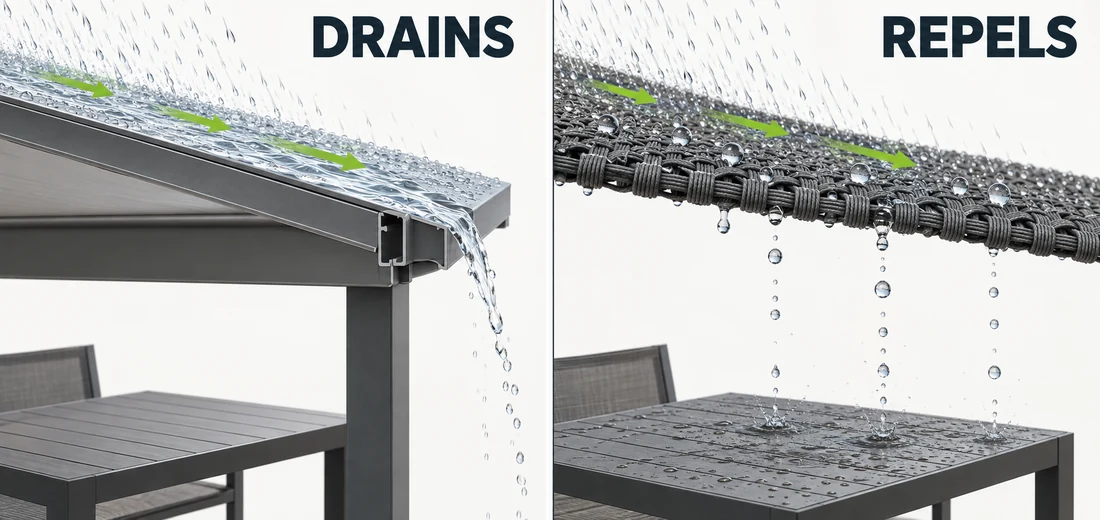
A roof that drains sheds water off a continuous surface. A roof that repels water slows it down. Fabric with a coating beads rain and passes it once the coating wets out or the rain gets heavy. Mesh stops sun and passes water by design. Both get listed as waterproof. One of the better ranked guides on this subject even carries a section headed water-repellent versus waterproof, then lists vines and shade sails among its waterproof ideas.
Worth saying where this is written from: alux builds louvred roofs, entry number 4, and they carry their own caveat. Two questions separate them. Does water leave the surface, or soak through it? And does the roof have somewhere to send what it sheds? An option that fails either is not a rain solution whatever the listing says. Waterproof pergola covers goes into the fabric side in detail.
| Option | Dry in an hour of steady rain? | Cost, 12×12 bay | Life |
|---|---|---|---|
| Polycarbonate panels | Yes, with adequate fall | $300 – 900 | 10 – 20 years |
| Metal sheeting | Yes | $500 – 1,400 | 30 years + |
| Glass | Yes | $4,000 + | Decades |
| Louvred roof, closed | Yes, except driven rain | $3,000 – 9,000 | Decades |
| Retractable canopy | Shower only | $400 – 4,000 | 8 – 12 seasons |
| Tensioned shade sail | Partly, at 15° or more | $120 – 400 | 5 – 8 seasons |
| Canvas or PVC cover | Yes while taut | $150 – 500 | 3 – 6 seasons |
| Shade cloth | No, permeable by design | $60 – 200 | 3 – 12 seasons |
| Climbing plants or lattice | No | $40 – 600 | Years to decades |
Four of the nine appear in waterproof product listings while failing the second column.
1. Polycarbonate panels
First of three that pass the test. The most common answer, and the one that gets the balance right for most gardens.
Corrugated or multiwall sheet fixed to purlins across the frame. Water runs straight off a dense surface. Light still comes through at 88 percent transmission on clear 6 mm grades and 62 percent on 16 mm triple-wall, and UV coatings block 99.9 percent of the ultraviolet while passing the visible light. That combination is why polycarbonate outsells the alternatives, and pergola roof types compared sets out how each behaves over years.
Dry in sustained rain Yes, with adequate fall. Cost 300 to 900 dollars for a 12 by 12 bay. Life 10 to 20 years.
The failure mode is not the panel. It is the fixings and the fall. Below the stated minimum pitch, water sits on the screw line instead of running off.
2. Metal sheeting
The most weather-resistant option on the list and the loudest.
Steel or aluminium in corrugated, R-panel or standing seam profile. Nothing here rots, tears, yellows or stretches, and a good coating holds for decades.
Dry in sustained rain Yes. Cost 500 to 1,400 dollars. Life 30 years plus.
Standing seam is the version with no fasteners through the roof field, so there are no washers to age. It is also the option with the highest minimum pitch to check, since exposed-fixing profiles want 3:12.
3. Glass
The one that costs most and delivers the clearest result.
Toughened or laminated glass in an aluminium frame, usually as part of a manufactured system, not something built on site. It stays dry, stays clear, and does not discolour the way plastic does.
Dry in sustained rain Yes. Cost 4,000 dollars and up. Life decades.
The weight is the constraint. Toughened glass at 8 mm runs 19.8 kg per square metre and at 10 mm 24.7, so a 12 by 12 bay hangs 300 kg or more off the frame. That is why glass arrives as a system with its own structure rather than as panels you fit to what you have.
Condensation is the other thing nobody mentions. Glass cools faster than the air beneath it, so on clear autumn nights it drips at the edges. A slope and a drip edge deal with it.
4. Louvred roof, closed
The one that is dry when you want it and open when you do not, with one caveat worth stating plainly.
Aluminium blades on a shared linkage. Closed, they overlap into a continuous surface that drains into a gutter formed inside the perimeter beam and down a hollow post, which is how alux and most manufacturers in the category build them.
Dry in sustained rain Yes, closed. Cost 3,000 to 9,000 dollars installed. Life decades.
The caveat: a closed louvred roof drains, it does not seal. Rain driven sideways by strong wind crosses the meeting edge between blades, and a gutter blocked with leaves backs up whatever the blades are doing. Marketing in this category says 100 percent waterproof, and that phrase appears on competitor product pages word for word. The accurate version is that it keeps you dry in the rain you will sit through, and it is the only option on this list that also opens.
5. Retractable fabric canopy
First of three that handle a shower and no more. Excellent at what it does, and routinely sold as more than it is.
Coated fabric panels on a track, drawn by hand or motor. In light rain the coating sheds water and the space stays usable.
Dry in sustained rain No. Cost 400 to 4,000 dollars. Life 8 to 12 seasons on the fabric.
Slack fabric pools in the middle and the pool deepens. Eventually the panel is holding several gallons over your head. Tensioned systems delay it. Nothing eliminates it, which is why motorised versions with rain sensors retract instead of closing.
6. Tensioned shade sail
A real rain option at the right angle and useless at the wrong one.
Fabric anchored at three or four points and pulled tight. Water beads and runs off provided there is enough slope, which is exactly what the better guides say and exactly what the photographs show being ignored.
Dry in sustained rain Partly, at 15 degrees or more of fall, which is 13 inches of drop across 4 feet. Cost 120 to 400 dollars. Life 5 to 8 seasons.
Two things go wrong. Flat sails pool and stretch. And a sail sheds everything it catches onto whatever is below the low corner, which is often a neighbour’s fence or your own back door.
7. Waterproof canvas or PVC covers
The budget route to a dry table, with a shorter horizon than the price suggests.
Coated canvas or PVC fitted over the top of the frame and tensioned. Genuinely waterproof material, and the failure is in how it is held rather than what it is made of.
Dry in sustained rain Yes while taut, no once it sags. Cost 150 to 500 dollars. Life 3 to 6 seasons.
Build in a peak or a slope when fitting. A flat cover collects water on day one.
8. Shade cloth
First of two sold under waterproof search terms and permeable by design.
Knitted polyethylene mesh. Product listings for this material carry waterproof in the title while the specification underneath states that the fabric allows air and water to pass through. Both statements appear on the same page.
Dry in sustained rain No. Cost 60 to 200 dollars. Life 3 to 12 seasons.
It is a good product. It blocks 70 to 90 percent of sun, it breathes so heat does not build underneath, and it costs very little. It is not a roof, and buying it expecting one is the most common disappointment in this category.
9. Climbing plants and lattice
Beautiful, useful, and not a rain answer.
Dense foliage slows rain and redirects some of it, and one of the guides in this category describes that as minimal waterproofing before listing it anyway. Lattice and slat panels break up rainfall the same way.
Dry in sustained rain No. Cost 40 to 600 dollars. Life years to decades.
Leaves also drop, which means a covered roof for five months and an open one for seven. That is a feature in a temperate garden and a problem anywhere the rain arrives in winter.
Fitting to a pergola you already have
Most people searching this already own the structure, and that narrows the list before price does.
Fabric options fit almost anything. A canvas cover, a sail or a retractable track goes onto a frame that was never designed to carry a roof. Loads stay small, and either the wind passes through or the system retracts.
Rigid options ask questions first. Polycarbonate, metal and glass all stop weather passing between the rafters and start handing it to the posts. Dead load, snow load and wind load rise at once. Three measurements answer it. Post section and footing depth against what the panel supplier specifies. Rafter spacing against the panel you intend to buy. Fall across the top.
Louvred systems, covered across the pergola with roof range, are not a retrofit at all. The blades, linkage, drive and drainage are one assembly and the frame is part of it, so the existing structure comes down.
Rough timeline A cover or sail goes up in an afternoon. Panels are a weekend. A louvred system is one to two days with a crew, after a lead time measured in weeks.
The three details that decide whether tier one stays tier one
A waterproof panel on a badly built roof leaks, and it leaks in the same three places every time.
Fall. Minimum pitch comes from the panel manufacturer, commonly 1:12 for polycarbonate and 3:12 for exposed-fixing metal. Below it water sits instead of running, and it sits on the fastener line.
Edges. Roofs leak at the eave, the ridge and the wall junction. Almost never in the middle of a panel. Closure strips fill the profile at the ends and barge flashing covers the sides. An attached roof needs its wall junction flashed into a chase, not sealed along the top with a bead of silicone.
Drainage. Integrated systems route water inside the beam and down a hollow post, which is how alux handles it and one of the real advantages of buying roof and frame together. alux routes it through the beam and down a hollow post; everything else needs a gutter. A pergola roof has none unless you fit one, and a bare edge discharges the whole roof area along one line, normally onto the paving at a post base. That is splash-back onto the post and, over a few winters, a channel scoured in whatever is underneath.
Wind is what turns a dry roof into a wet one
Every figure above assumes rain falling more or less straight down, and rain rarely does.
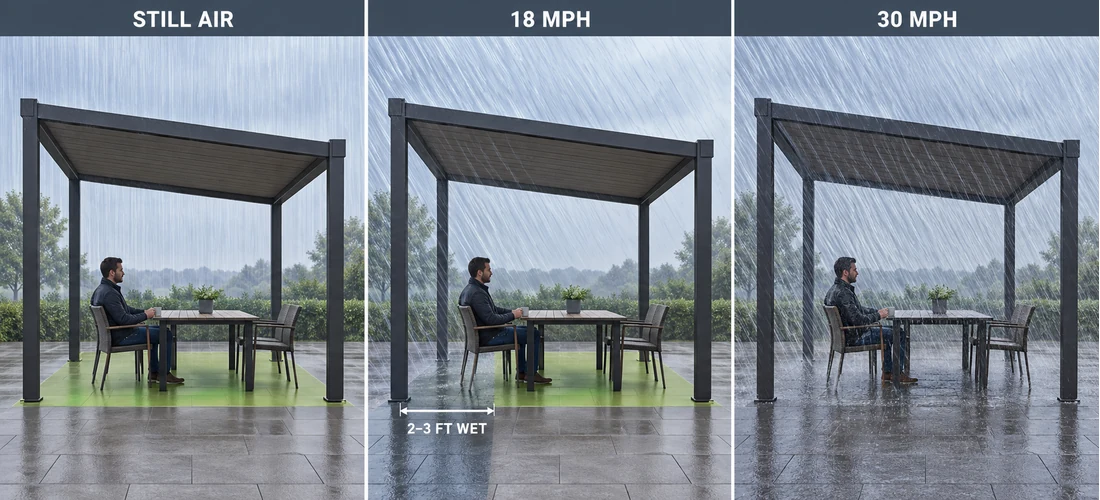
Wind drives rain sideways, and a pergola is open on four sides. At 18 mph a roof that sheds perfectly in still conditions puts water 2 to 3 feet in under the eave, which on a 12 foot bay is a quarter of the floor. At 30 mph the whole space is wet regardless of what is overhead.
This is why the tiers above are about the roof and not about the space. Keeping a seating area dry in weather means something vertical on the windward side, whether that is a screen, a blind or a wall. A roof alone handles vertical rain and hands you the rest.
Two practical consequences. Orient the seating away from the prevailing wind if the layout allows it, since that is free. And if the structure is exposed, budget for one side from the start instead of discovering the need in the first autumn.
Choosing between them
Three questions get you to an answer without reading the list twice.
Do you need to sit out in real rain, or just avoid getting caught? Real rain means tier one. Getting caught means tier two is enough and costs a fraction.
Do you want the sky back in winter? A fixed panel is a permanent decision, and from November to March it keeps out light you now want. Retractable and louvred systems both answer that; panels do not.
Is there an existing frame? Panels and louvres ask different things of a structure. A solid roof stops shedding weather between the rafters and starts handing it to the posts, and the frame has to have been sized for it or strengthened before anything goes on.