

Ten aluminum pergola manufacturers, each entry carrying the specifications that can be checked, not the adjectives that cannot. Alloy and temper. Coating standard. Where the extrusion is drawn. Whether engineering arrives stamped. Companies in this category call their aluminum premium or aircraft-grade. Very few print the four-digit number that would let you compare one to another.
What to check in an aluminum pergola, and why these four
Aluminum pergolas differ in ways that photographs do not show, and four specifications carry most of the difference.
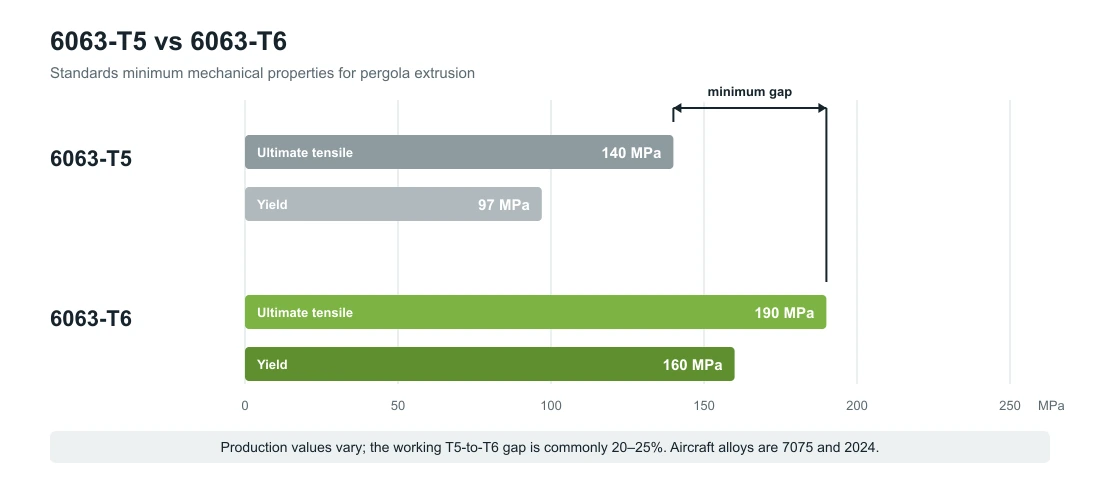
Alloy and temper come first. Pergola extrusion across the louvered pergola category is 6063, the architectural alloy, and the temper after it is what varies. 6063-T5 is air cooled from the extrusion press and artificially aged. 6063-T6 gets a full solution treatment and quench first, and the standards set its minimum ultimate tensile at 190 MPa against 140 MPa for T5, with yield at 160 MPa against 97. Typical production values land higher on both, and the working gap sits at 20 to 25 percent. That shows up as span between posts and as how thin a section can be drawn while holding tolerance. A company printing 6063-T6 is telling you something. A company printing aircraft-grade is not, since aircraft alloys are 7075 and 2024 and neither appears in a garden.
Coating standard second. Powder coat is universal in this category and the specification underneath is not. AAMA 2603, 2604 and 2605 represent 1, 5 and 10 years of South Florida exposure at 45 degrees facing south, and the gap between the ends of that range is the difference between a finish that holds and one that chalks.
Those two interact. AAMA ratings test the coating, and the coating sits on whatever was extruded. A 2605 finish over a thin T5 section buys colour retention on a part that will deflect. Specification is a set, not a menu.
Origin third. Where a company assembles and where its extrusion is drawn are separate questions, and several firms answer only the first.
Engineering fourth. A stamped engineering package is what a building department accepts. A wind rating in a brochure is what a sales page contains. How each of these four turns into a line item is covered in what custom actually means on a quotation.
| Manufacturer | Alloy published | Wall thickness published | Structural report by number | Made in |
|---|---|---|---|---|
| alux | 6063-T5 | Yes, 2.0 / 1.2 mm | Yes, TÜV Rheinland | Jiangxi, China |
| Renson | Not stated | No | Figures published, Miami-Dade on Camargue | Waregem, Belgium |
| StruXure | “Aircraft-grade”, 50% recycled | No | Miami-Dade NOA and ICC | Georgia and Nevada, USA |
| Azenco | Not stated | No | Miami-Dade NOA | Miami USA and France |
| Solisysteme | Not stated | No | Origine France Garantie | Avanton, France |
| The Luxury Pergola | 6063-T6 | No | Not published | USA, own facility |
| Pergolux | 6063-T5 | No | Not published | Norwegian founded |
| Structureworks | Not stated | No | Stamped package on request | USA |
| Progolas | 6063-T5 | No | Not published | Guangzhou, China |
| Seroban | Not stated | No | Not published | Changzhou, China |
Four of ten publish an alloy grade. One publishes wall thickness. Compiled from each company’s own public material.
1. alux, Jiangxi
Jiangxi, China. alux builds louvred aluminum and steel systems for OEM and ODM supply.
Publishes section dimensions instead of descriptions: the aluminum AL-120-A-KD pairs a 120 by 120 mm post with a 158.8 by 34.7 mm blade, at 2.0 mm wall on the post and 1.2 mm on the blade. Extrusion is 6063-T5. Wind is tested to EN 13561 Class 6 under TÜV Rheinland, and the report is supplied on request with the tested model named on it.
alux sells factory direct as OEM and ODM, which means the product carries the buyer’s name. Minimum order is one set, unusual at this end of the market and the reason a distributor can hold a physical sample before committing a container. Terms sit under the OEM and ODM programme.
Where it does not lead. On published performance figures alux does not top this list. StruXure states a wider rotation and Renson higher wind and snow numbers, both on their own technical pages.
2. Renson, Belgium
Waregem, Belgium. Camargue and Aero louvred systems, sold through certified dealers.
The most complete published dataset in the category. Blades rotate through 0 to 150 degrees, wind resistance is given to 120 km/h with blades closed, load capacity to 110 kg per square metre, on a maximum single span of 4500 mm by a 6200 mm pivot. Coating runs 60 to 80 microns including texture, against a 2604 minimum of 30. The Camargue carries Miami-Dade certification.
Renson also publishes a drainage throughput, 0.04 to 0.05 litres per second per square metre sustained for two minutes, referenced to Belgian rainfall statistics under NBN B 52-011. Nobody else on this page publishes a drainage figure at all.
What it does not offer. Any route to a badged product. This is a brand with an installer network, and the guarantee begins when an approved fitter signs off.
3. StruXure, United States
Georgia and Nevada, United States. Pivot 6 and Cabana X, sold through authorised dealers.
Aircraft-grade is used here too, though the substance underneath is real. Extrusion is drawn from 50 percent recycled aluminum and louvre rotation reaches 170 degrees. Patented water management routes rain through the structure with no external gutters. Somfy motors come as standard. Certification covers Miami-Dade NOA and ICC evaluation, which is the pairing a commercial specifier wants. Seven United States manufacturing facilities across two states. Acquired by The AZEK Company in 2022.
Warranty is the strongest published here: transferable lifetime limited against manufacturing defects, 15 years structural, 5 years on power systems.
What it costs. 150 to 200 dollars per square foot installed, the highest in this comparison.
4. Azenco, France and Florida
Miami, Florida, plus production sites in France. Part of Hunter Douglas.
The R-BLADE system uses a dual-wall gapless louvre that closes without visible gaps between blades, which is a genuine engineering difference rather than a finish detail. Weather sensors are standard, not an upgrade. Somfy motors, with integration for Alexa, Google, Siri and Control4. Miami-Dade NOA for hurricane-zone installation. Installed pricing runs 80 to 120 dollars per square foot, roughly 43 percent under StruXure at the midpoint.
Warranty reads 15 years structural, 5 years motor, 3 years electronics, and that tiering is worth reading as a set and not as a headline. The longest term sits on extruded aluminum, which is the part least likely to fail.
5. Solisysteme, France
Avanton, France. Founded 1998.
Often credited with inventing the bioclimatic pergola, and production has stayed in France since. Configurations are customisable, with integrated lighting and automated controls available. The Origine France Garantie certification is an audited claim about where manufacturing happens, which is more than an origin statement in this category usually amounts to.
What is thinner. Published structural figures are harder to find than with Renson, and distribution outside Europe is limited.
6. The Luxury Pergola, United States
United States, own facility, family owned.
The only entry here specifying 6063-T6 instead of T5, which is a real difference and worth the ink. T6 costs more to produce because of the extra heat treatment, and it trades some ductility for the strength: elongation drops from 8 percent to 5. Finish is ElectroLayer powder coat. The company states that it designs, engineers and builds every unit at its own facility, with no imported parts assembled, and that structures are made to order with sizing to the half inch. Warranty is lifetime.
Two claims need reading carefully. Aircraft-grade attached to 6063 is marketing, since aircraft alloys are 7075 and 2024. And a lifetime warranty on a mechanical assembly is worth whatever the issuing company’s lifespan turns out to be. That is a different quantity from a five year term backed by a named test report.
7. Pergolux, Norway
Norwegian founded, shipping across North America and Europe.
6063-T5 powder-coated extrusion, integrated drainage with a built-in gutter and sloped louvres channelling rainwater down the two front columns. Standard and custom sizes. Motorised roof operating by remote, app or smart home, with louvre-integrated LED lighting on the Pro series.
Pergolux is also one of the few in this category to state a methodology when comparing itself to others, saying it used manufacturers’ own websites and BBB profiles as sources. That is a low bar and still higher than the category norm.
Worth noting. Its own guidance advises leaving the slats open when the pergola is not in use, so the structure does not become a wind trap. That is an honest instruction and one that most brands leave out of the sales page.
8. Structureworks, United States
United States. Commercial and residential engineered aluminum.
The entry to call when the project needs a stamped engineering package. Structureworks runs a preliminary engineering analysis specific to project location and site conditions for any structure that may later need full stamping, which is a workflow and not a marketing line. Design range runs to curves, cantilevers, arches and angles no kit system can produce.
Who it suits. Architects and commercial specifiers. It is not a homeowner purchase and does not pretend to be.
9. Progolas, Guangzhou
Guangzhou, China. Factory direct, global export.
Standardises on 6063-T5 and sells the complete system direct to homeowners and contractors, with no dealer layer in between. The proposition is premium features at a factory-direct price, and on specification it holds up against brands costing several times more.
What to verify. Published detail stops at alloy grade. Coating specification, salt spray hours and test report references are not stated, which is the due diligence gap across most of this segment rather than a criticism of this company alone.
10. Seroban, Changzhou
Changzhou, China. French design roots, Chinese manufacturing.
Adjustable and retractable aluminum systems built around modular adaptability, with smart integration. Export markets cover North America, Europe and the Middle East. The positioning is European design at Chinese production cost, a real and defensible middle ground, and where Hanso and Pergolux are made traces the same question through two other brands.
What to verify. As across this segment, the published specification stops at material and feature level. Ask for the coating standard and the structural report before comparing prices.
The aluminum specification nobody publishes: wall thickness
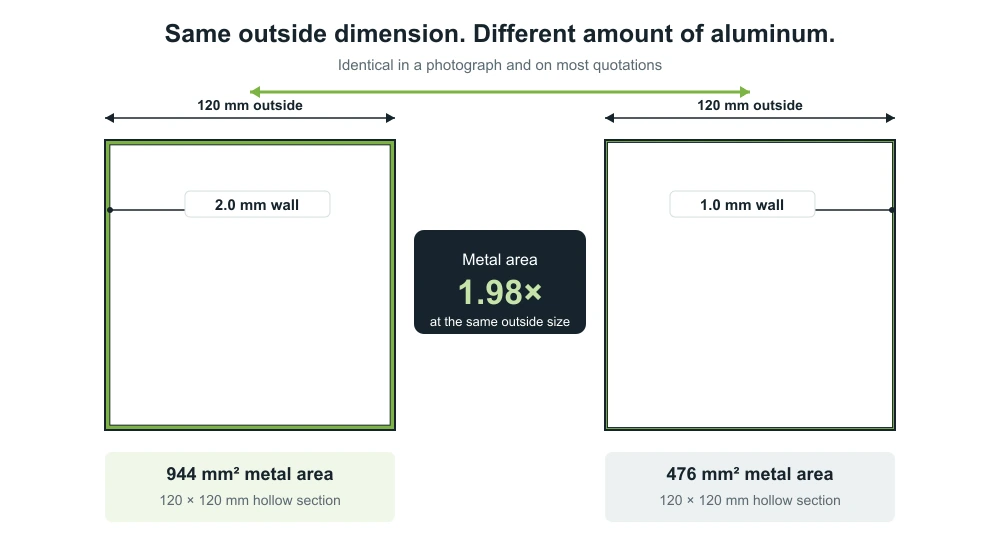
Alloy grade appears on most of these pages. Wall thickness appears on almost none, and it decides more than the grade does.
A section is described by its outside dimensions, and that describes almost nothing. A 120 by 120 mm post at 2.0 mm wall carries 944 mm² of metal in section. The same outside dimension at 1.0 mm carries 476, which is 1.98 times less. The thinner one costs less, weighs less, ships more units per container, and buckles sooner at the point where a blade pivot seats into it. From a photograph the two are indistinguishable. From a quotation they usually are too.
alux states 2.0 mm on the post and 1.2 mm on the blade alongside the outside dimensions, which is the pairing worth asking every supplier for. Outside dimensions without wall thickness describe a silhouette.
The same applies to coating. Microns of powder appear occasionally; what sits underneath appears rarely. Pretreatment chemistry and any metallic base layer are what decide whether the finish is still attached in year twelve, and neither is visible on delivery.
What the gaps tell you about each manufacturing region
Read the table sideways and a pattern appears that is more useful than the ranking.
European manufacturers publish structural numbers. Renson gives wind, snow, span and drainage figures. American manufacturers publish certifications. Miami-Dade and ICC appear repeatedly because the United States market runs on them. Chinese manufacturers publish material grade and price, and stop.
None of those three is dishonest. They reflect what each market asks for. A buyer working across markets has to ask for whatever the supplier has not volunteered, and the list of what is missing differs by origin.
Two questions close most of the gap. What is the alloy and temper, in full, including the letter after the number. And what report covers the wind or snow figure, by reference number instead of by class.
Choosing an aluminum pergola manufacturer on more than list position
Rankings are only useful with the criteria attached, and the criteria change with the buyer.
For a named architectural project, specification depth and certification matter most. That puts Renson, StruXure, Azenco and Structureworks at the top, with price a long way down the list.
For a homeowner buying one structure, what matters is a dealer nearby and someone who still answers in year five. Both outweigh everything on this page. A good local installer of a mid-range system beats a remote supplier of a better one.
For a distributor building a catalogue, the question is not who makes the best pergola but who will make yours. That removes every branded system here regardless of engineering quality, and leaves the factory-direct entries. Where published feedback fits into that decision is covered in how to read pergola reviews.